How Long Do Laminate Worktops Really Last?

The average laminate worktop lifespan ranges from 10 to 15 years, depending heavily on the quality of installation and your daily maintenance routines.

  • Maximum Longevity: Premium high-pressure laminate surfaces can last up to 15 years if the core is properly sealed against water ingress.

  • Common Failures: Poorly sealed joints and incorrect sink choices drastically reduce the laminate worktop lifespan to under 5 years due to chipboard swelling.

  • Heat Damage: Direct contact with hot pans will immediately scorch the wear layer, causing irreparable blistering and ruining the surface.

  • Expert Verdict: Professional, millimeter-precise fitting is the single most critical factor in achieving the maximum possible laminate worktop lifespan.

Understanding Your Laminate Worktop Lifespan Realities

Evaluating your expected laminate worktop lifespan requires looking beyond the decorative surface to the core composite material beneath. As seasoned kitchen installers, we routinely remove ten-year-old surfaces that look flawless, alongside three-year-old boards completely destroyed by water.

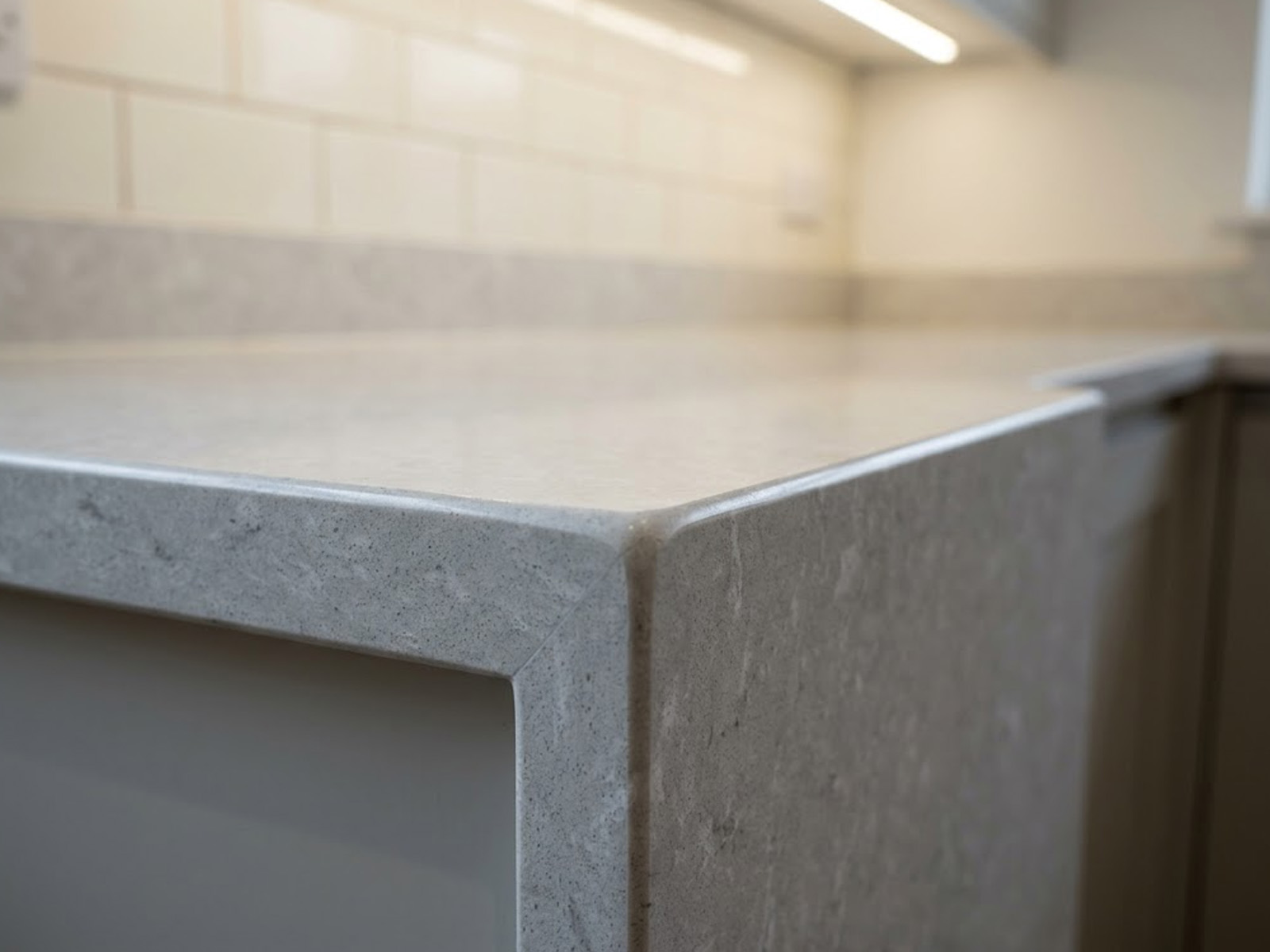
The difference in longevity always comes down to structural cabinet preparation and millimeter-precise joint fabrication completed in the workshop. A perfectly routed and silicone-sealed mason’s mitre joint is absolutely essential for protecting the vulnerable high-density particleboard core.

Factors Influencing the Laminate Worktop Lifespan

The overall laminate worktop lifespan is dictated by how well the surface resists daily culinary impacts, heat, and moisture. High-pressure laminates feature a tough, scratch-resistant overlay, but this protective barrier is extremely thin compared to natural stone.

If water penetrates this top layer through a scratched surface or a poorly sealed edge, the timber core will inevitably swell. You can browse our premium Laminate worktops designed with advanced moisture-resistant cores to combat these exact kitchen hazards.

Core Material Quality and Thickness

Selecting a 38mm or 40mm thick board generally improves your laminate worktop lifespan because it offers superior structural rigidity. Thinner 22mm boards are highly trendy but require perfectly level base cabinets to prevent flexing and subsequent joint failure.

We frequently see homeowners place these thinner boards on unlevel units, creating immense physical tension that rips the sealed joints apart. Ensuring your cabinetry is structurally sound before fitting is the only way to prevent these catastrophic material failures.

Water Ingress and Seal Integrity

Water ingress around sink cutouts is the leading cause of a drastically shortened laminate worktop lifespan in British kitchens. We apply generous, continuous beads of high-grade sanitary silicone around all raw edges to lock out moisture permanently.

If you are attempting to install the surfaces yourself, you must understand the risks involved with improper sealing techniques. Read our comprehensive guide on can you fit laminate worktops yourself to avoid these costly moisture mistakes.

Common Customer Mistakes Reducing Laminate Worktop Lifespan

One of the most frequent errors that ruins a laminate worktop lifespan is choosing the wrong type of kitchen sink. We constantly advise against fitting undermount sinks with composite boards, as the exposed core cannot withstand constant water exposure.

Instead, you must opt for a high-quality drop-in sink with a wide stainless steel lip that overlaps the decorative surface. This overlap, when bedded on premium silicone sealant, creates an impenetrable barrier that protects the delicate chipboard beneath.

Thermal Damage from Hot Pans

Unlike engineered quartz, exposing these composite surfaces to intense heat will instantly terminate your laminate worktop lifespan. Placing a boiling kettle or a hot roasting tin directly onto the counter will scorch and melt the protective resin overlay.

Comparing Laminate Worktop Lifespan with Premium Alternatives

When budgeting for a renovation, comparing the laminate worktop lifespan against engineered stone provides a realistic view of long-term value. While composite boards are highly affordable upfront, their shorter lifespan means you may replace them twice before a quartz slab fails.

Our fabrication team works with both materials, allowing us to provide highly transparent advice on which surface suits your culinary lifestyle. The table below outlines the expected longevity, maintenance demands, and structural vulnerabilities of popular bespoke kitchen surfaces.

Worktop MaterialExpected LifespanWater Resistance at CoreHeat Resistance
Premium Laminate10 – 15 YearsVery Low (Core swells)Low (Scorches easily)
Engineered Quartz25+ Years100% WaterproofModerate
Natural GraniteLifetimeHighly ResistantExceptional


Maximising Your Laminate Worktop Lifespan Through Professional Fitting

Securing the longest possible laminate worktop lifespan heavily relies on employing skilled tradesmen utilizing professional routing equipment. We utilize heavy-duty half-inch plunge routers and dedicated worktop jigs to create perfectly flush, watertight corner seams.

Attempting to cut these complex joints with a standard jigsaw leaves a jagged edge that is physically impossible to seal against water. Hiring a professional guarantees that your joints remain pristine, safeguarding the structural integrity of your entire kitchen.

Budgeting for Your Kitchen Renovation

Understanding the true costs associated with professional fitting helps you maximize your laminate worktop lifespan without overspending. Investing slightly more in expert installation saves you from replacing water-damaged boards just a few years down the line.

To accurately plan your renovation budget, we highly recommend reading our detailed breakdown regarding the laminate worktop cost UK. This transparent guide highlights exactly where your money goes during a bespoke kitchen upgrade.

Health, Safety, and Ethical Fabrication Standards

Manufacturing and cutting kitchen surfaces generates fine dust particulates that must be managed to protect occupational health. Our modern workshop utilizes advanced industrial extraction systems to capture hazardous airborne dust immediately at the cutting source.

We operate in complete, uncompromising compliance with the strict workplace safety regulations enforced by the gov.uk Health and Safety Executive. This ethical commitment ensures our skilled tradesmen work safely while crafting premium surfaces for your home.

The Austin Laminate Direct-to-Consumer Advantage

Choosing an independent specialist is the best way to secure a fantastic laminate worktop lifespan without paying inflated showroom prices. By managing the supply and professional fitting internally, we eliminate expensive middlemen and unnecessary retail markups completely.

At Austin Laminate, our integrated business model means we handle your digital templating, precision routing, and final installation. This streamlined, direct-to-consumer approach guarantees absolute quality control and exceptional long-term value for your property.

Book Your Accurate Consultation Today

Stop relying on vague showroom estimates and secure a highly accurate quotation tailored exactly to your kitchen dimensions. Our experienced team is ready to guide you through texture options, edge profiles, and professional fitting requirements.

Let our dedicated experts transform your kitchen with guaranteed engineering precision and a highly resilient finish. Request your Instant free quote through our secure online portal and lock in a transparent, competitive price today.
Can You Fit Laminate Worktops Yourself? A Step-by-Step DIY Guide

Yes, completing a DIY laminate worktop fitting is entirely possible if you possess strong carpentry skills, but it demands strict millimeter precision to prevent permanent moisture damage.

  • Skill Level: Requires confident handling of heavy-duty routers and power saws.

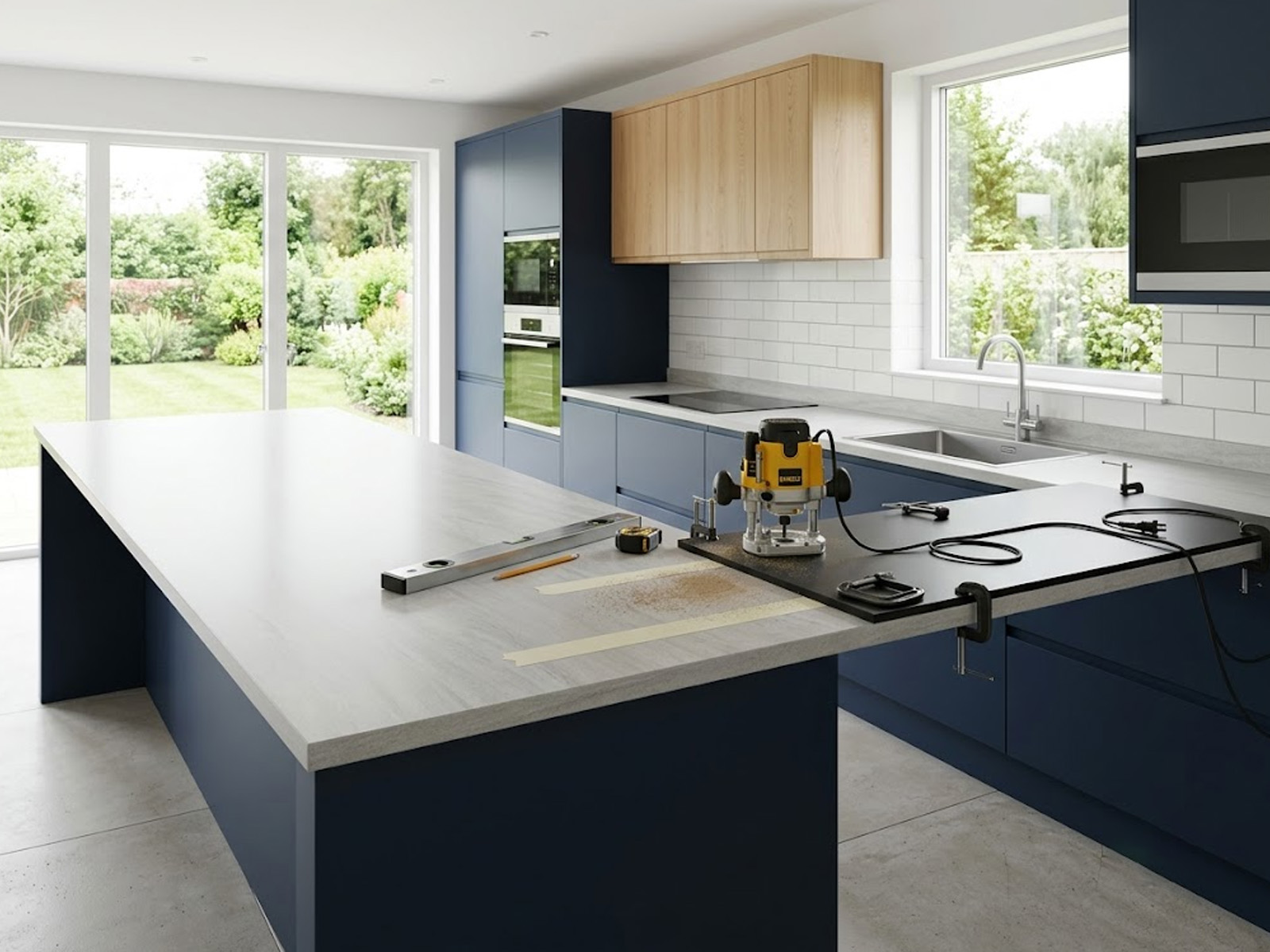
  • Essential Tools: A professional worktop jig and a ½-inch router are non-negotiable for creating seamless mason’s miter joints.

  • Moisture Risks: Any incorrectly sealed cut edge will rapidly absorb water, causing the internal chipboard core to swell and fail.

  • Professional Alternative: While DIY saves on labor, hiring experts guarantees flawless joints and eliminates the risk of ruining expensive materials.

Understanding the Reality of DIY Laminate Worktop Fitting

Executing flawless DIY laminate worktop fitting requires far more than simply placing a heavy board onto your kitchen cabinets. As professional installers, we see firsthand the disastrous results when enthusiastic property owners underestimate the structural engineering required for a waterproof finish.

Your success hinges entirely on achieving millimeter precision during the cutting and joining phases, particularly around complex corner layouts. While high-pressure composite surfaces are incredibly durable on top, their exposed chipboard core is highly vulnerable if exposed to any kitchen moisture.

We spend years mastering the exact routing speeds and blade depths necessary to prevent the decorative wear layer from chipping. If you are committed to a DIY laminate worktop fitting, you must be prepared to invest in the correct professional-grade routing tools.

Is DIY Laminate Worktop Fitting Suitable for Beginners?

Attempting a DIY laminate worktop fitting as your very first carpentry project is incredibly risky and generally not advised. A single misplaced cut or poorly routed joint will completely ruin a full-length slab, costing you significantly more in replacement materials.

If your kitchen layout features multiple corners, uneven walls, or complex undermount sink requirements, we highly recommend seeking professional assistance. The technical demands of joining these surfaces securely go far beyond basic DIY measuring and cutting.

Essential Tools Required for DIY Laminate Worktop Fitting

The success of your DIY laminate worktop fitting relies entirely on the quality of the cutting tools you bring to the kitchen. You cannot achieve a watertight, professional-looking joint using a standard handsaw or a basic jigsaw.

You will strictly need a high-powered ½-inch plunge router, a brand new tungsten carbide router bit, and a heavy-duty worktop jig. Additionally, having a precise digital spirit level, robust G-clamps, and colour-matched jointing compound is absolutely mandatory for a seamless finish.

Why Routing Jigs Matter in DIY Laminate Worktop Fitting

A professional jig is the defining tool in any successful DIY laminate worktop fitting, dictating the accuracy of your mason’s mitre joints. It acts as a rigid template, guiding your plunge router to cut perfectly interlocking male and female joint profiles.

Without this specialized template, it is physically impossible to create the incredibly tight, flush seam required to keep water out of the core. Attempting to join two slabs using cheap metal joining strips often looks unprofessional and significantly reduces the lifespan of your surface.

Step-by-Step DIY Laminate Worktop Fitting Guide

The initial phase of your DIY laminate worktop fitting involves strictly verifying the structural integrity of your supporting cabinetry. You must confirm that your walls are structurally sound and that the layout provides sufficient anchor points for the heavy boards.

Before making a single cut, place the oversized slabs onto the base units to visualize exactly where your joints and appliances will sit. This dry-run strategy allows you to adjust your cut lines, ensuring that your final joints do not sit directly above washing machines or dishwashers.

Measuring-Masking-Tape-DIY-Preparation

Preparing Your Cabinets Before DIY Laminate Worktop Fitting

The most catastrophic mistake we witness during DIY laminate worktop fitting is property owners attempting to install boards onto unlevel cabinets. If your base units deviate by even two millimeters, the rigid board will twist, instantly blowing apart your freshly glued corner joints.

Measuring and Cutting Slabs During DIY Laminate Worktop Fitting

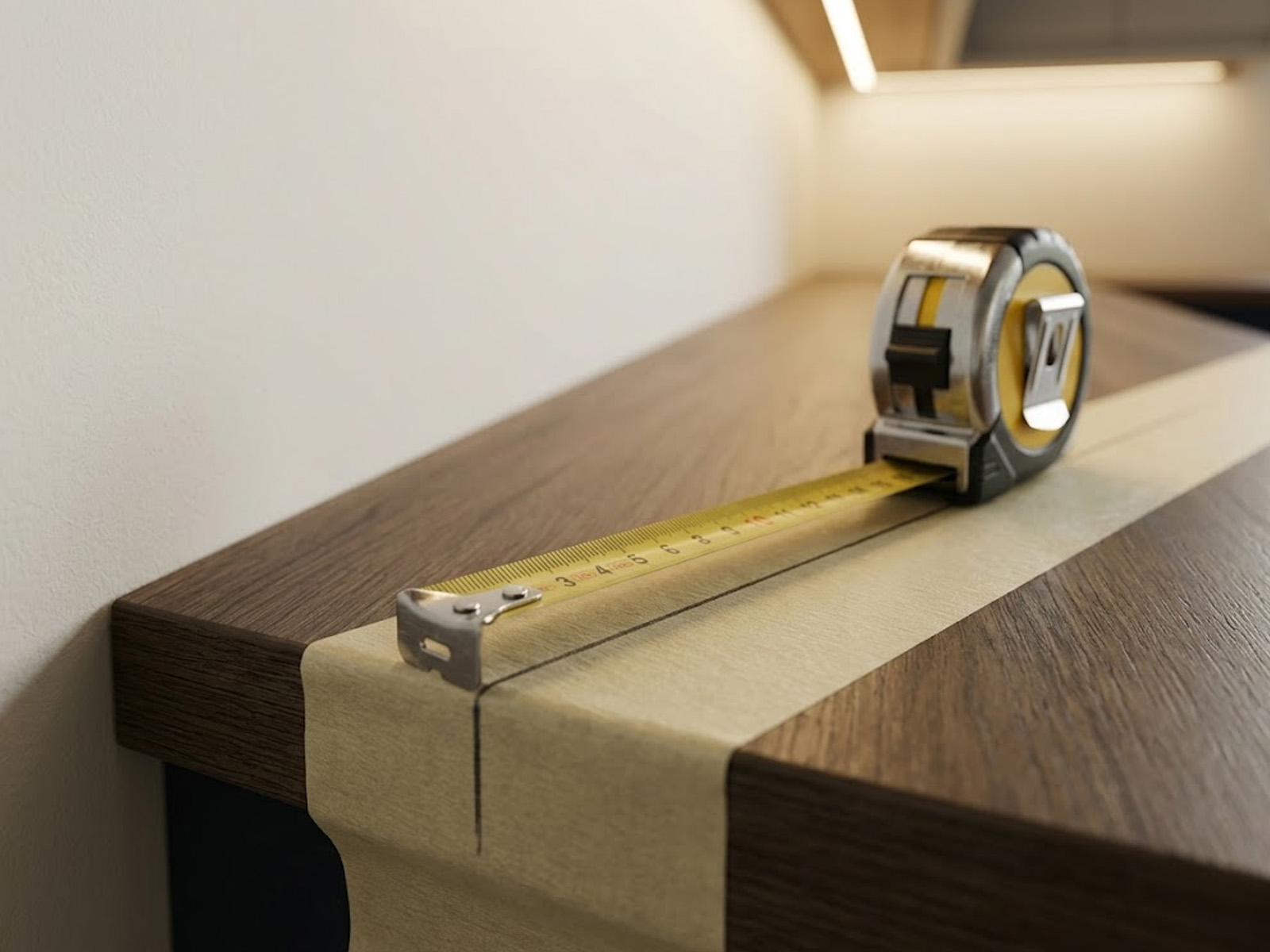
When you reach the cutting stage of your DIY laminate worktop fitting, remember the golden rule: measure three times, cut once. Apply masking tape over your intended cut line before using a circular saw, as this simple trick dramatically reduces the risk of the decorative surface chipping.

Creating Seamless Joints for Your DIY Laminate Worktop Fitting

Creating a waterproof seam is the ultimate test of your DIY laminate worktop fitting skills and requires immense patience. Once your male and female cuts are precisely routed, apply a generous bead of color-matched jointing compound along the entire exposed core.

Bring the two slabs together quickly and tighten them from underneath using specialized mechanical worktop connecting bolts. As you tighten the bolts, the excess sealant will squeeze out of the top; wipe this away immediately to leave a perfectly flush, nearly invisible seam.

Common Mistakes Seen in DIY Laminate Worktop Fitting

Rushing the measuring phase is the fastest way to ruin a DIY laminate worktop fitting, leading to costly material replacements. We frequently replace DIY installations where the homeowner failed to leave a sufficient expansion gap against the masonry walls.

If the board is wedged tightly against the brickwork, the natural expansion of the timber core during seasonal humidity changes will buckle the surface. Always leave a strict 3mm to 5mm expansion gap around the perimeter, which you can easily hide later with matching upstands or tiles.

Poor Sink Choices in DIY Laminate Worktop Fitting

Selecting the wrong basin type is a disastrous error frequently made during a DIY laminate worktop fitting project. You must strictly avoid undermount sinks, as the exposed chipboard core around the rim cannot withstand constant exposure to sitting water.

Always opt for a high-quality drop-in sink with a wide, robust stainless steel lip that sits securely on top of the decorative surface. You must apply a thick, continuous bead of waterproof silicone beneath this lip to ensure moisture never reaches the vulnerable core material.

Cost Savings: Professional vs DIY Laminate Worktop Fitting

Calculating the true value of your DIY laminate worktop fitting requires looking beyond the raw material price tags. While installing the surfaces yourself eliminates professional labour charges, you must factor in the cost of hiring specialised routing jigs and heavy-duty power tools.

If you malaboratastrophic cutting error, purchasing a replacemspecializedll instantly wipe out any financial savings you initially anticipated. Sometimes, relying on the guaranteed precision of a master stonemason or dedicated installer is the smartest long-term financial decision.

Installation MethodAverage Tool Hire CostLabour FeesRisk of Material RuinExpected Joint Quality
DIY Installation£80 – £150£0HighVariable (Depends on skill)
Professional Fitting£0£150 – £400Zero (Insured)Exceptional (Seamless)


Calculating Your Total DIY Laminate Worktop Fitting Expenses

To accurately benchmark your DIY laminate worktop fitting budget, you must research the baseline material costs in your specific region. For a transparent breakdown of typical material prices, review our dedicated guide covering the laminate worktop cost UK.

If you realize that purchasing the required tools makes the DIY route too expensive, it may be time to consider premium alternatives. Exploring quartz vs granite worktops can open your eyes to materials that offer lifetime durability and absolute water resistance.

Workplace Safety During a DIY Laminate Worktop Fitting

Prioritising your physical health is absolutely paramount during any DIY laminate worktop fitting procedure inside your home. Plunge routers operate at terrifying speeds, and losing control of the machine can result in severe, life-altering injuries within a fraction of a second.

Furthermore, cutting composite timber boards generates highly hazardous fine dust particulates that can severely damage your respiratory system. You must wear a high-quality, certified particulate respirator mask and safety goggles throughout the entire cutting and routing process.

For guidance on safe workshop practices and dust extraction requirements, we highly recommend consulting the official guidelines on gov.uk. Taking these professional safety standards seriously ensures your home renovation project does not compromise your personal well-being.

Why Direct Fabrication Improves DIY Laminate Worktop Fitting Results

Securing the best raw materials for your DIY laminate worktop fitting means bypassing high-street showrooms and their inflated retail margins. By sourcing your slabs directly from a dedicated supplier, you guarantee superior material quality and a much fairer price point.

At Austin Laminate, we offer a stunning range of high-pressure composite surfaces designed for modern, demanding British kitchens. Whether you plan to fit them yourself or utilize our professional teams, we provide materials engineered for ultimate longevity and style.

If you are intimidated by the precision routing required, our in-house fabrication team can supply boards pre-cut to your exact dimensions. This hybrid approach removes the stress of cutting joints yourself while still saving you money on the final on-site installation labor.

Book Your Precision Estimate Today

Stop struggling with complicated cutting calculations and let our seasoned experts assist you with your upcoming kitchen renovation. Our team is ready to guide you through texture selections, matching upstands, and custom edge profiling techniques.

Explore our extensive catalog of premium Laminate worktops to find the perfect aesthetic match for your bespoke cabinetry. We guarantee a flawless finish that dramatically elevates the visual appeal and functionality of your property.

Submit your kitchen plans today to lock in a highly competitive, transparent quotation without any hidden fees. Request your Instant free quote through our secure online portal and take the stress out of your kitchen upgrade today.

Budget-Friendly Kitchen Updates: The Cost of Laminate Worktops

When calculating the standard laminate worktop cost in the UK, homeowners should expect highly affordable pricing compared to premium engineered stone.

  • Average Material Prices: Standard lengths typically range from £60 to £150 per three-meter slab.

  • Bespoke Fabrication: Custom CNC cutting for sinks, tap holes, and seamless joints adds £100 to £300.

  • Professional Fitting: Expert installation services generally contribute an additional £150 to £400 to the total bill.

  • Total Estimate: The total laminate worktop cost in the UK for a fully fitted, average-sized modern kitchen usually falls between £400 and £900.

Breaking Down the True Laminate Worktop Cost in the UK

Understanding the true laminate worktop cost uk requires evaluating both the raw materials and the precision fabrication required. The initial price tag on a mass-produced slab rarely reflects the final installed figure for a functioning kitchen.

As seasoned fabricators, we consistently remind clients that bespoke cutting drastically alters the final quotation. Preparing cutouts for hobs and sinks requires strict millimeter precision to ensure your appliances fit perfectly without subsequent structural failure.

How Material Thickness Affects Your Laminate Worktop Cost UK

Choosing between a slimline 22mm profile and a chunky 40mm profile directly impacts your overall laminate worktop cost uk. Thicker slabs demand more core material and robust edge banding, naturally commanding a slightly higher retail price.

However, these thicker profiles offer superior structural rigidity across wide spans, such as large breakfast bars or islands. Investing in a robust thickness prevents sagging and ultimately delivers significantly better long-term value for your property.

High-Pressure Textures and the Laminate Worktop Cost UK

Advanced high-pressure textures that mimic natural wood or stone will increase your baseline laminate worktop cost uk slightly. These premium finishes provide a stunning aesthetic that rivals more expensive materials without the associated maintenance headaches.

We frequently install these textured surfaces for clients wanting a luxurious, bespoke finish on a strictly controlled budget. Our team ensures the protective wear layer remains completely intact during the precision routing and edging process.

Common Mistakes That Inflate the Laminate Worktop Cost UK

Failing to prepare your kitchen structurally is a guaranteed way to inflate your final laminate worktop cost uk unexpectedly. The most critical mistake we encounter on-site is homeowners presenting completely unlevel wooden base cabinets for our installation team.

When we place a rigid, heavy surface onto unlevel units, it creates massive physical tension across the mason’s mitre joints. This uneven weight distribution inevitably leads to blown joints and water ingress, requiring a complete, expensive replacement.

Precision-Digital-Templating-UK

Poor Sink Choices and the Laminate Worktop Cost UK

Selecting incompatible plumbing fixtures heavily impacts your overall laminate worktop cost uk and the lifespan of the surface. We always advise against undermount sinks for these surfaces, as the exposed chipboard core is highly vulnerable to moisture.

Choosing a high-quality drop-in sink with a perfectly sealed rim is the only way to guarantee absolute longevity. A poorly sealed tap hole or sink cutout will swell rapidly, completely ruining your newly fitted kitchen within a few months.

Fabrication Precision and Your Laminate Worktop Cost UK

Precision engineering in the workshop is the absolute best way to optimize your total laminate worktop cost in the UK safely. We utilize advanced digital templating to map your room, ensuring every cut is planned with strict millimeter accuracy before fabrication begins.

To see how this level of precision translates across our services, review the quartz worktop installation process detailed by our team. Our approach eliminates messy on-site cutting, guaranteeing a flawless mason’s mitre joint that seals perfectly against moisture and bacteria permanently.

Health, Safety, and the Laminate Worktop Cost UK

Responsible manufacturing inherently influences the laminate worktop cost in the UK, as professional workshops must maintain strict occupational safety standards. Cutting composite boards generates fine dust and particulates, requiring advanced industrial extraction systems to protect our skilled fabrication team.

Our modern facility operates in absolute compliance with the rigorous workplace regulations enforced by the gov.uk Health and Safety Executive. This unwavering commitment ensures your custom surfaces are produced ethically in a clean, highly controlled environment.

Comparing the Laminate Worktop Cost in the UK to Other Materials

Evaluating the laminate worktop cost in the UK alongside premium engineered stone reveals a massive financial saving for budget-conscious renovators. While it lacks the sheer heat resistance of stone, it provides exceptional aesthetic value and practicality for a fraction of the price.

If your budget allows for a material upgrade, you might explore our detailed guide covering quartz worktop prices uk for comparison. Understanding these different pricing tiers helps you align your material choice perfectly with your specific daily culinary lifestyle.

Worktop MaterialAverage Supply & Fit CostJoint VisibilityWater Resistance at Core
Premium Laminate£400 – £900Visible (Requires colour-fill)Low (Must be edge-banded)
Engineered Quartz£1,500 – £3,500Nearly Invisible100% Waterproof
Natural Granite£1,800 – £4,000Nearly InvisibleHighly Resistant


Direct Fabrication Lowers Your Laminate Worktop Cost in the UK

Bypassing high-street retail showrooms is the most effective strategy to reduce your overall laminate worktop cost uk significantly. Because we handle the entire fabrication process internally, we completely eliminate the massive retail markups applied by middlemen.

At Austin Laminate, our direct-to-consumer model ensures you pay solely for premium materials and expert British craftsmanship. This streamlined approach guarantees exceptional quality control and seamless communication throughout your entire kitchen renovation journey.

Book Your Accurate Laminate Worktop Cost UK Estimate

Stop relying on vague showroom guesses and secure a highly accurate laminate worktop cost UK tailored to your specific dimensions. Our experienced team is ready to guide you through texture options, matching upstands, and custom edge profiling techniques.

You can explore our extensive catalog of durable Laminate worktops to find the perfect aesthetic match for your new cabinetry. We guarantee a flawless, stress-free installation that dramatically elevates the visual appeal and functionality of your home.

Submit your kitchen plans today to lock in a highly competitive, transparent quotation without any hidden installation fees. Request your Instant free quote through our secure online portal and schedule your professional digital laser survey today.

How Eco-Friendly Are Engineered Quartz Worktops?

Yes, sustainable quartz worktops are increasingly eco-friendly, driven by industry shifts towards recycled materials and safer manufacturing processes.

  • Recycled Content: Modern premium slabs integrate recycled glass, mirrors, and porcelain alongside natural quartz minerals.

  • Reduced Silica: Advanced manufacturing technologies (like Cosentino’s HybriQ+) significantly lower crystalline silica levels, improving workshop safety.

  • Water Recycling: Professional fabrication facilities utilise closed-loop water systems, recycling 100% of the water used during CNC wet-cutting.

  • Longevity: The extreme durability and non-porous nature of the stone ensure it lasts decades, vastly reducing landfill waste compared to laminate.

Unpacking the Reality of Sustainable Quartz Worktops

Evaluating the true environmental impact of sustainable quartz worktops requires looking at the entire lifecycle of the material, from manufacturing to installation. As master stonemasons, we handle massive volumes of engineered stone, and we witness the industry’s rapid evolution towards greener practices firsthand.

In the past, engineered stone relied entirely on freshly quarried quartz and high volumes of synthetic polymer resins. Today, the composition is radically changing; premium brands are actively formulating slabs that utilise high percentages of post-consumer recycled materials.

This shift does not compromise the legendary structural integrity of the stone. The intense vibro-compression technology ensures these recycled elements are bound tightly, maintaining the 100% non-porous, highly hygienic finish that modern British homes demand.

How Recycled Materials Create Sustainable Quartz Worktops

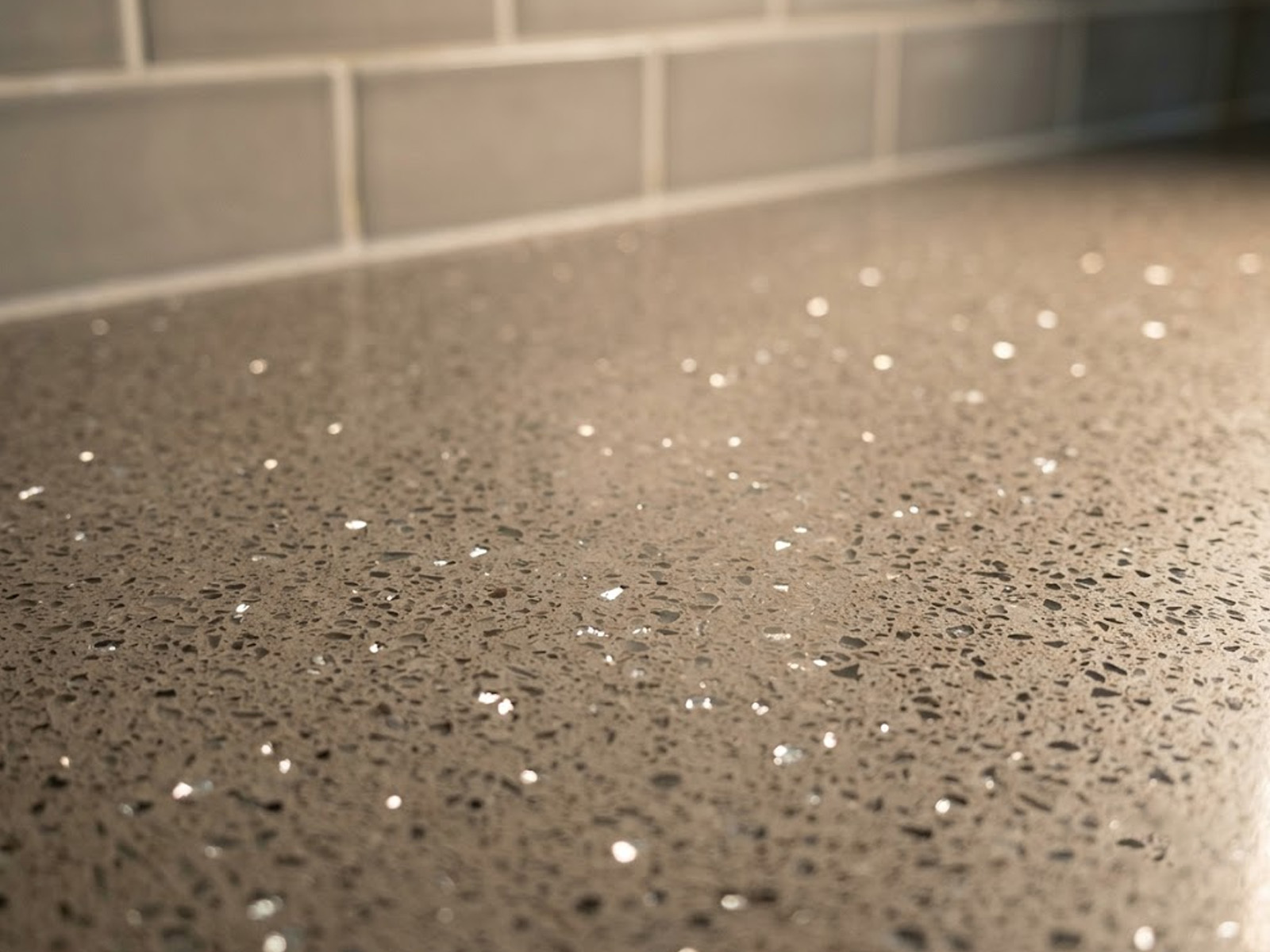
The most significant advancement in producing sustainable quartz worktops is the aggressive integration of recycled glass and mirror flecks into the slab matrix. By diverting industrial glass waste from landfills, manufacturers drastically reduce the need for virgin quartz mining.

The HybriQ+ Revolution and Lower Crystalline Silica

The push for greener materials has also driven a massive reduction in crystalline silica content, a critical development for occupational health. Traditional engineered stone contains up to 90% silica, which poses severe respiratory risks during the cutting and polishing phases.

Technologies like HybriQ+ replace a substantial portion of this silica with a premium blend of recycled minerals. If you are comparing leading brands, reading our analysis on silestone vs caesarstone will highlight how these low-silica formulations are changing the market.

This reduction directly protects the stonemasons operating our CNC machinery while delivering a product that meets stricter global environmental standards. It is a vital step forward in ensuring the kitchen industry remains both luxurious and ethically responsible.

Eco-Friendly Fabrication: Water Recycling and Dust Suppression

The sustainability of your new kitchen surface is heavily dictated by how it is fabricated before it ever reaches your property. Cutting dense engineered stone generates hazardous silica dust and requires immense volumes of water to cool the diamond-tipped CNC blades.

Why Digital Templating Reduces Material Waste

A hidden environmental cost in kitchen renovations is the material waste generated by inaccurate measurements and botched on-site cutting. Attempting to cut heavy slabs manually often results in chipped edges, forcing fabricators to discard entire lengths of premium stone.

We eliminate this waste by utilising highly precise digital laser templating to map your kitchen’s unique dimensions to strict millimetre tolerances. This data allows our CNC machines to nest the cuts perfectly on the slab, maximising material yield and minimising offcuts.

For a detailed walkthrough of this efficient, low-waste process, review what to expect during a professional quartz worktop installation. Precision engineering is fundamentally the most effective way to reduce environmental waste during a renovation.

Recycled-Glass-Quartz-Macro

Longevity: The Ultimate Environmental Benefit

When assessing the eco-credentials of sustainable quartz worktops, their sheer longevity makes them vastly superior to cheaper, disposable alternatives. A high-quality engineered stone surface will easily last for decades without degrading, warping, or losing its factory polish.

In contrast, cheap laminate worktops are highly susceptible to water damage, delamination, and heat scorch marks, often requiring full replacement within a decade. Every time a kitchen is ripped out and replaced, it generates a massive volume of non-recyclable landfill waste.

By investing in premium Quartz kitchen surfaces, you are installing a permanent architectural feature that will likely outlast the cabinetry supporting it. Durability is the cornerstone of true sustainability in modern home design.

Maintaining Your Stone to Maximise Its Lifespan

To ensure your investment genuinely lasts a lifetime, you must maintain the stone correctly to protect the polymer resins. Using highly acidic descalers or abrasive scouring pads will chemically degrade the surface, leading to premature dulling.

We strictly advise adhering to safe, pH-neutral cleaning routines to preserve the non-porous hygiene of the slab. You can find comprehensive, stonemason-approved maintenance instructions in our guide on how to clean quartz worktops.

Furthermore, you must avoid placing hot roasting pans directly onto the cold stone, as thermal shock can crack the resin binder. Protecting the structural integrity of your worktops prevents the need for environmentally costly replacements.

The Austin Direct-to-Consumer Value and Sustainability

Choosing an independent, direct-to-consumer fabricator is the smartest way to secure ethically produced stone without paying inflated showroom prices. By managing the entire manufacturing sequence internally, we significantly reduce the carbon footprint associated with transporting slabs between multiple third-party contractors.

At Austin Laminate, our integrated business model guarantees absolute quality control from the initial laser survey to the final flush joint. We handle the digital templating, the wet-cut CNC fabrication, and the professional installation ourselves.

To understand the financial benefits of this streamlined approach, review our transparent breakdown of Quartz Worktop Costs in the UK. You secure exceptional engineering precision while directly supporting sustainable, low-waste manufacturing practices.

Secure Your Bespoke Kitchen Estimate Today

Stop relying on vague online calculations and secure a highly accurate, transparent quotation tailored exactly to your kitchen dimensions. Our in-house specialists are ready to guide you through material selections, recycled content options, and precise joint placement.

Let our master stonemasons transform your kitchen into a highly durable, eco-conscious space with guaranteed engineering precision. Submit your kitchen plans today and request an Instant free quote through our secure online portal.

The Ultimate Buyer’s Guide to Choosing High-Quality Quartz

When consulting a comprehensive buying quartz worktops guide, your primary focus must be on selecting high-grade, resin-bound stone that offers complete non-porosity and structural integrity.

  • Material Composition: Ensure the slab contains approximately 90% natural quartz aggregates for maximum durability against impact and scratches.

  • Thickness Options: Choose between 20mm for sleek, modern aesthetics or 30mm for traditional, robust spans that require less structural support.

  • Finish Types: Select a polished finish for high stain resistance or a honed finish for a contemporary, organic matte look.

  • Fabrication Precision: Always insist on digital laser templating and CNC water-jet cutting to guarantee flawless, millimetre-precise joints.

Navigating the Buying Quartz Worktops Guide: What to Look For

Understanding what separates premium stone from cheap alternatives is the foundation of any reliable buying quartz worktops guide. As experienced stonemasons, we handle massive slabs daily and know exactly how different manufacturing processes affect the final product’s durability.

Premium engineered stone is produced using advanced vibro-compression technology under extreme vacuum pressure. This industrial process entirely eliminates microscopic air pockets, ensuring the final slab is completely non-porous and structurally sound.

If a manufacturer cuts corners during this pressing stage, the resulting stone will be prone to chipping during the CNC milling process. This is why we rigorously source only the highest quality materials for our Bespoke quartz worktops, guaranteeing a flawless finish for every bespoke kitchen project.

Understanding Quartz Quality and Composition

The exact ratio of natural quartz crystals to synthetic polymer resins heavily dictates the scratch and heat resistance of your new kitchen surfaces. High-quality slabs maintain a 90% mineral composition, providing the hard-wearing resilience that busy UK households demand.

Lesser quality imports often use a higher percentage of cheap resins, which makes the stone significantly more vulnerable to thermal scorch marks and UV fading. Always ask your fabricator about the specific brand and composition of the stone before committing to a purchase.

Evaluating Thickness: 20mm vs 30mm Profiles

Deciding between a 20mm or 30mm profile is a critical step in your journey, heavily influencing both the visual aesthetic and the required cabinetry support. A 20mm thickness is the current favourite for contemporary, minimalist designs featuring handleless kitchen units.

Conversely, 30mm stone provides a substantial, monolithic appearance that suits traditional Shaker-style kitchens perfectly. While thicker slabs are heavier and slightly more expensive, their inherent rigidity often means they require fewer structural supports over large spans.

Common Mistakes Highlighted in Our Buying Quartz Worktops Guide

A crucial aspect of any professional quartz worktop buying guide is helping property owners avoid disastrous structural and aesthetic errors. We frequently arrive on-site to find clients have made fundamental mistakes during the preparatory stages of their kitchen renovation.

The most catastrophic error is failing to ensure the wooden base cabinets are perfectly true and level before our installation team arrives. If you place a heavy, rigid stone slab onto an uneven frame, the uneven weight distribution creates massive internal tension that will inevitably cause stress fractures.

Another frequent oversight is selecting complex, deeply recessed sink drainer grooves without considering the structural implications. These intricate cutouts must be precisely milled in our factory, as attempting them on-site with manual tools risks chipping the stone and generating hazardous dust.

Quartz-Edge-Profile-Comparison

Choosing the Wrong Edge Profile for Your Lifestyle

Selecting a sharp, 90-degree square edge profile might look incredibly modern, but it is highly susceptible to impact damage in a busy family kitchen. Heavy cast-iron pans easily chip sharp stone corners, leading to expensive and frustrating repair work.

We always advise our clients to choose a slightly rounded pencil, a bevelled, or a bullnose edge profile to deflect daily impacts safely. Rounded edges distribute physical force much more effectively, preserving the pristine condition of your bespoke installation for decades.

Misjudging the Reality of Heat Resistance

Many homeowners mistakenly believe that engineered stone is completely heat-proof, which leads to severe resin scorch marks. While the natural quartz minerals are stable, the synthetic polymer resins binding them will melt or crack if exposed to direct heat exceeding 150°C.

You must always use protective wooden trivets or integrated stainless steel hot rods to keep boiling pans away from the polished surface. Establishing this simple daily habit is the single most effective way to protect your long-term kitchen investment.

Aesthetic Considerations in Your Buying Quartz Worktops Guide

Matching your new stone to your existing cabinetry and lighting is a defining element of this buying quartz worktops guide. The sheer variety of pigments and veining patterns available means you can perfectly tailor the stone to your home’s unique architectural style.

We always recommend viewing a full-sized slab rather than relying on a tiny four-inch sample square provided in a showroom. Small samples cannot accurately represent how large, sweeping Calacatta veins or subtle mirror flecks will actually flow across a massive kitchen island.

Selecting Veining Patterns and Colours

Solid greys and fine-grained patterns are incredibly forgiving, making it very easy for our stonemasons to create virtually invisible joint seams. These uniform designs are perfect for minimalist spaces where you want the cabinetry to remain the primary visual focus.

Heavily veined marble-effect designs require highly skilled digital templating to ensure the patterns match perfectly across any necessary joints. This vein-matching process demands immense precision and artistic planning to ensure the final installation looks like a continuous, organic piece of rock.

Polished vs Matte Finishes

A highly polished finish is the traditional choice, offering a mirror-like gloss that reflects light beautifully and is exceptionally easy to wipe clean. The smooth surface gives liquid spills and greasy fingerprints absolutely nothing to cling to, making it highly sanitary.

Honed or suede finishes provide a gorgeous, velvety matte texture that absorbs light, creating a grounded, contemporary industrial aesthetic. However, you must be aware that matte finishes hold onto finger oils more readily and require slightly more frequent daily wiping.

To understand exactly how to care for these different textures safely, consult our dedicated article on how to clean quartz worktops. Using the correct, non-abrasive cleaning methods guarantees your chosen finish will last a lifetime.

Budgeting and Value: A Buying Quartz Worktops Guide to Costs

Navigating the financial aspects of your renovation is a pivotal chapter in our buying quartz worktops guide. Understanding exactly what factors drive the final price ensures you allocate your renovation budget efficiently without compromising on engineering quality.

The final quotation involves far more than just the raw material; it encompasses digital templating, complex CNC cutting, edge polishing, and professional fitting. Complex additions like seamlessly matched full-height splashbacks or recessed sink cutouts naturally increase the required manufacturing time.

To help you benchmark your budget effectively, we have compiled a structural and financial comparison of premium materials. The table below outlines how engineered stone performs and prices against natural alternatives.

Material TypePorosityMaintenance RequirementAverage Fabrication Complexity
Engineered Quartz100% Non-PorousVery Low (Wipe clean)High (Requires CNC precision)
Natural GraniteNaturally PorousHigh (Annual sealing)Exceptionally High
High-End LaminateNon-PorousLow (Wipe clean)Low (Can be cut on-site)


For a highly detailed breakdown of average UK pricing structures, we strongly advise reading our comprehensive analysis of Quartz Worktop Costs in the UK. Thorough financial planning ensures you can comfortably afford the precision craftsmanship your home deserves.

Bypassing Middlemen with Direct Fabrication

Securing the best value for your bespoke kitchen means strictly avoiding traditional high-street showrooms that inflate prices with massive retail markups. By managing the entire process internally, independent fabricators can offer vastly superior pricing on premium slabs.

At Austin Laminate, our direct-to-consumer business model guarantees that you only pay for premium materials and master craftsmanship. We handle the digital laser templating, the wet-cut CNC fabrication, and the final professional installation entirely in-house.

This streamlined approach eliminates costly delays and ensures absolute quality control from the initial survey to the final polish. If you are ready to secure a transparent, highly accurate price, request an Instant free quote through our secure online portal today.

Health, Safety, and Fabrication Standards

A responsible quartz worktop buying guide must address the rigorous safety standards required to manufacture these dense stone products. Cutting engineered slabs generates fine crystalline silica dust, which poses severe respiratory risks if inhaled by workshop staff.

Our modern fabrication facility operates with advanced wet-cutting CNC machinery that completely suppresses and captures this hazardous dust at the source. We take our occupational health responsibilities incredibly seriously, ensuring a safe, clean environment for our master stonemasons.

Our operations comply entirely with the strict workplace safety regulations enforced by the gov.uk Health and Safety Executive. This unwavering commitment guarantees that your bespoke surfaces are crafted ethically and arrive at your property completely uncontaminated.

Finalising Your Project: Templating and Installation

The final step in your quartz worktop guide journey is preparing your home for the physical installation. We utilise highly advanced digital laser templating to map your kitchen’s unique dimensions to strict millimetre tolerances before any cutting begins.

This precise data is fed directly into our CNC machines, guaranteeing that complex corner joints and appliance cutouts align perfectly. It completely eliminates the need for messy, hazardous on-site cutting, ensuring a smooth and rapid fitting day.

If you are still debating whether engineered stone is the right choice compared to natural rock, review our expert comparison of quartz vs granite worktops. Let our dedicated team of professionals deliver a flawless, high-value finish that transforms your property for decades to come.

Can You Use Quartz Worktops in an Outdoor Kitchen or BBQ Area?

No, standard indoor/outdoor quartz worktops are strictly not recommended for outdoor kitchens or BBQ areas exposed to direct sunlight. While the natural quartz minerals are highly durable, the polymer resin binders and pigments used to engineer the slabs degrade rapidly under ultraviolet (UV) radiation.

  • UV Degradation: Prolonged sun exposure breaks down synthetic resins, causing severe yellowing in white slabs and dramatic fading in darker colours.

  • Thermal Shock: Extreme temperature swings from chilly British winters to hot summer BBQs cause the resin to warp or crack.

  • Warranty Void: Most premium manufacturers specifically void their product warranties if indoor slabs are fitted in external environments.

  • The Solution: You must exclusively specify certified exterior-grade slabs or opt for completely UV-stable natural granite or sintered stone.

The Science of UV Rays on Standard Engineered Slabs

Understanding why standard outdoor quartz worktops struggle in open-air environments requires looking at the raw material composition. Engineered stone consists of roughly 90% natural quartz aggregates bound tightly together using approximately 10% polymer acrylic resins and colour pigments.

As experienced stonemasons, we understand that while natural quartz minerals are entirely stable under the sun, the synthetic resin binder is highly vulnerable to photo-oxidation. When UV rays strike the worktop, they break the chemical bonds within the polymer matrix, resulting in a dull, yellowish, or patchy appearance.

Thermal Cycling and the British Weather

The UK climate presents unique challenges for any external installation, subjecting surfaces to rapid freeze-thaw cycles. While a non-porous slab resists rain and moisture absorption beautifully, the physical expansion and contraction under temperature swings can be catastrophic.

Because polymer resins and natural stone minerals expand at completely different rates when heated by direct sunlight or BBQ burners, internal stress builds up within the slab. This physical tension eventually leads to micro-fissures and sudden structural cracking, especially around cutouts for sinks and grills.

Our fabrication facility utilises advanced digital laser templating to ensure that if you are installing a certified outdoor stone, the joints are engineered to tolerate this movement. Failing to allow for thermal expansion during installation is a massive mistake that will ruin your bespoke garden living space.

Preventing Damage with Strategic Design and Covers

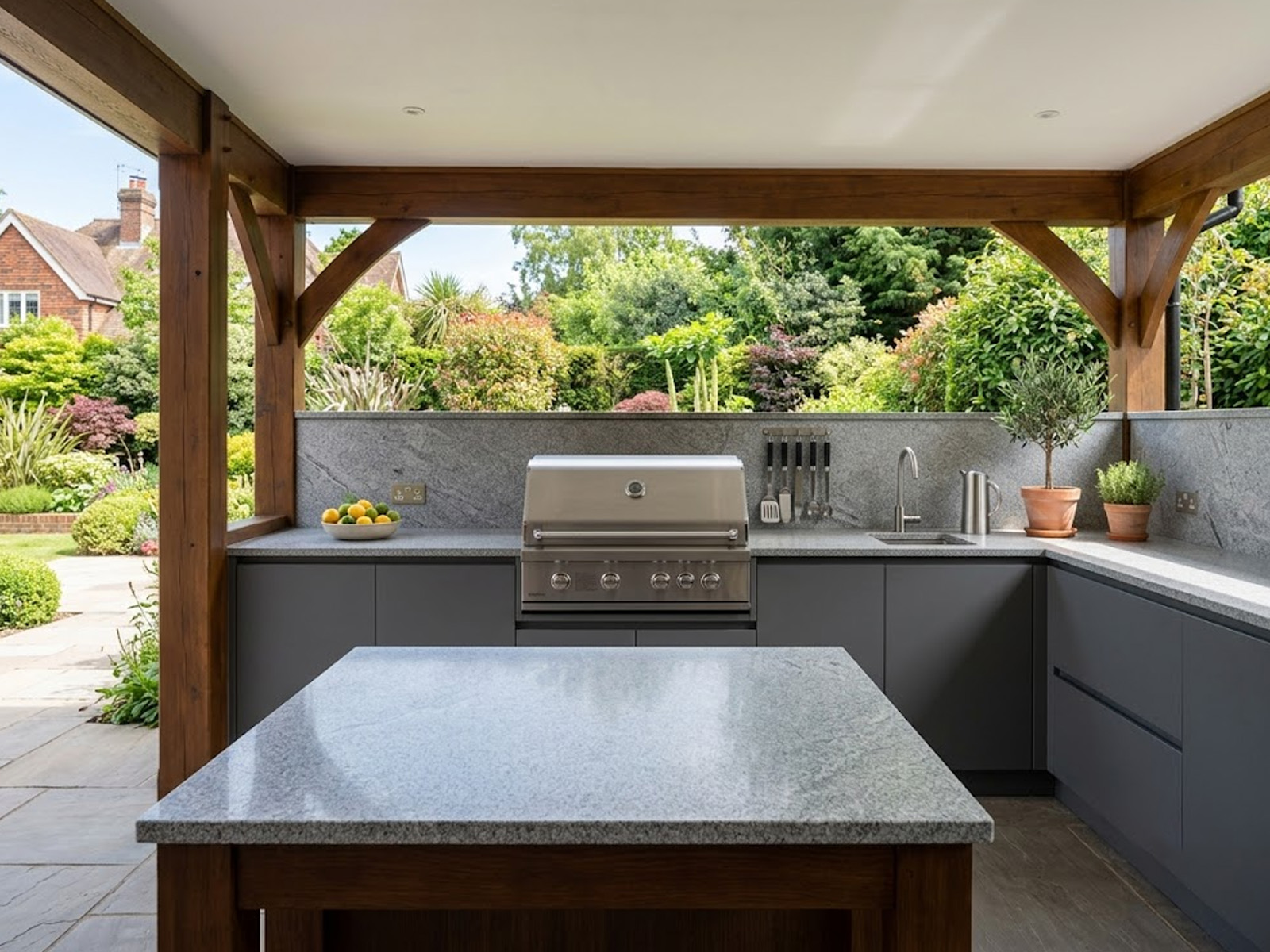
If you are absolutely set on using engineered stone for your garden kitchen, you must design the space to minimise environmental exposure. Installing the worktops under a permanent, solid gazebo or roof canopy blocks the majority of harmful direct UV rays.

Additionally, utilising heavy-duty, waterproof winter covers shields the stone from extreme winter frost and direct afternoon sun when the BBQ is not in use. These protective steps, combined with choosing lighter, sandy patterns, help mitigate the visual effects of gradual UV weathering over several years.

For those looking to build a resilient indoor-outdoor transition, exploring Bespoke quartz worktops designed with UV-stable resins is a viable path. However, you must always verify the manufacturer’s technical datasheets to ensure the specific colour range is rated for exterior application.

Comparing Outdoor Worktop Materials for UK BBQs

Choosing the ideal surface for your patio or BBQ area requires balancing raw durability, weather resistance, and fabrication costs. Sintered stones and premium natural granites remain the most reliable choices for surviving the unpredictable British weather without losing their colour.

Our stonemasons process these tough materials daily, using specialised wet-cutting CNC machinery to prevent micro-fracturing along the edges. The table below compares how standard quartz performs outdoors against alternative premium kitchen materials.

Worktop MaterialUV Fade ResistanceFreeze-Thaw StabilityStain & Moisture ResistanceRequired Maintenance
Standard QuartzPoor (Yellows/Fades)Moderate (Resin may crack)Outstanding (Non-porous)Low (Simple wipe clean)
Natural GraniteOutstanding (No fading)Excellent (Stable stone)Moderate (Requires sealing)Annual chemical sealing
Sintered StoneExceptional (100% stable)Exceptional (Frost-proof)Outstanding (Non-porous)Low (Simple wipe clean)

Natural-Granite-Outdoor-Texture

Why Natural Granite Remains a Classic Outdoor Choice

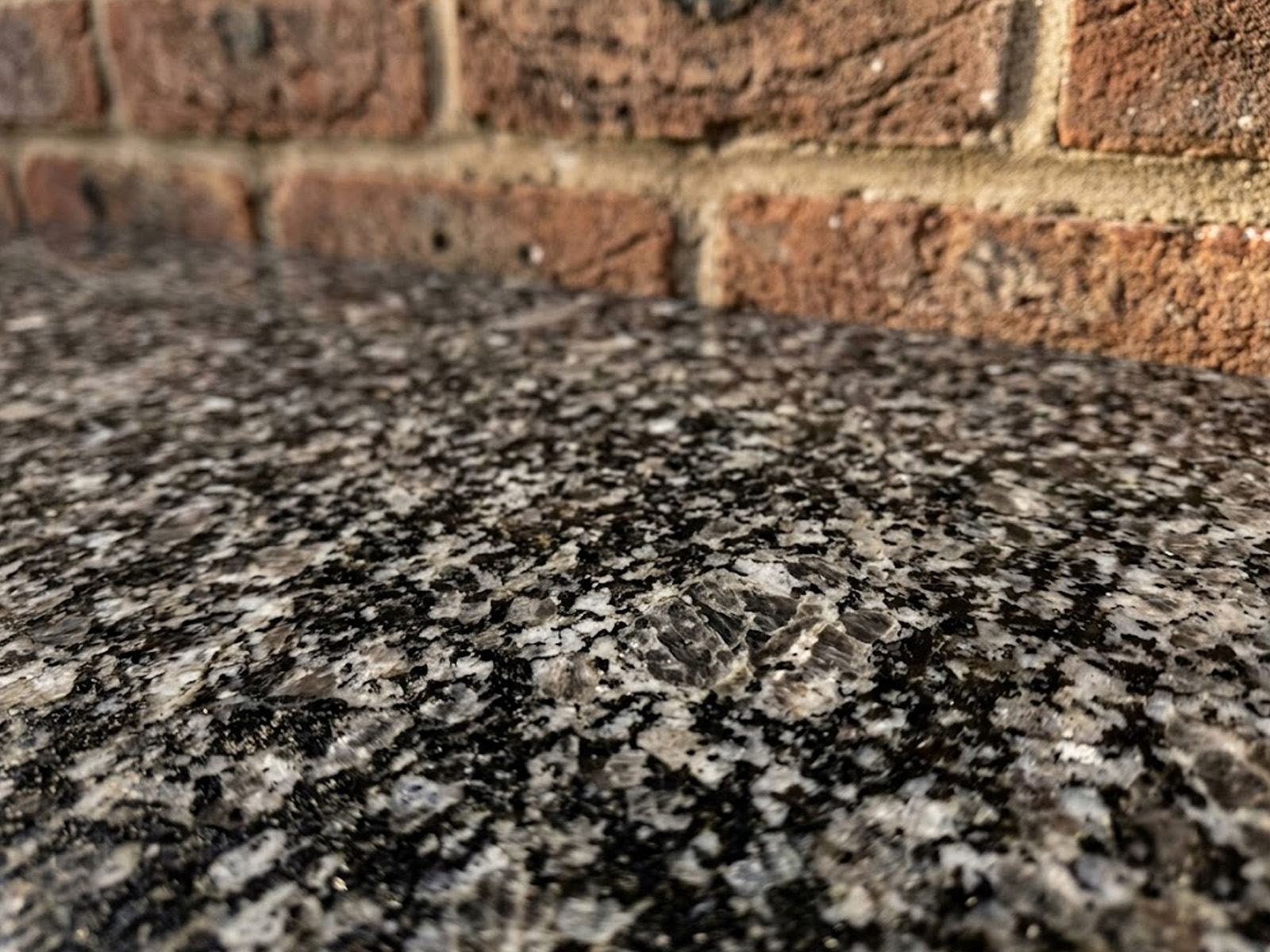
Natural granite is formed under intense volcanic heat and pressure, making it exceptionally stable when exposed to direct sunlight and extreme cold. Because it contains zero synthetic resins, it will not fade, yellow, or warp even after decades of exposure to harsh UV radiation.

However, because granite is naturally porous, you must apply a high-quality impregnating sealer every twelve months to prevent grease stains. For a detailed breakdown of how these stone types compare structurally, see quartz vs granite worktops.

Common Installation Errors in Outdoor Kitchen Projects

Failing to build a perfectly level, rigid foundation is the single most common mistake we see in DIY outdoor kitchen builds. Stone slabs are incredibly heavy, and any slight movement or settling in your patio slabs or timber framing will place immense physical stress on the joints.

Furthermore, attempting to cut complex sinks and BBQ hobs on-site using manual dry-cutting tools is a recipe for disaster. On-site cutting generates hazardous dust, risks chipping the polished edges, and lacks the millimetre precision achieved in our controlled workshop.

To understand how these fabrication factors affect your total project budget, we suggest checking out Quartz Worktop Costs in the UK. Proper planning ensures you invest your budget into correct structural support rather than costly structural repairs.

The Dangers of Poor BBQ Cutout Planning

BBQ grills radiate immense heat downward and outward, which can easily scorch the edges of your stone worktop if not insulated correctly. You must install specialised heat jackets or stainless steel trim kits to keep the intense heat of the burners away from the stone.

We always advise customers to read our safety guide, Can You Put Hot Pans Directly on Quartz Worktops?, before planning their outdoor cooking layouts. Using the correct heat barriers ensures your stone surfaces survive hot culinary sessions without cracking.

Safe Fabrication and Professional Installation Standards

Fabricating dense engineered stone and natural rock generates fine crystalline silica dust, which must be strictly managed to protect human health. Our modern, state-of-the-art facility operates in absolute compliance with the strict regulations set by the gov.uk Health and Safety Executive.

We utilise advanced wet-cutting CNC machinery and high-efficiency air filtration systems to completely suppress and capture hazardous dust. This unwavering commitment to safety protects our master stonemasons while guaranteeing that your custom-milled slabs arrive clean and uncontaminated.

Adhering to these rigorous professional standards ensures your bespoke outdoor kitchen is fitted with absolute engineering precision. Working with a certified, experienced team prevents costly installation errors and guarantees a stunning, long-lasting finish.

The Austin Direct-to-Consumer Advantage

Choosing an independent, direct-to-consumer stone specialist is the best way to secure premium worktops without paying inflated high-street prices. By managing the entire process internally, we eliminate expensive middlemen, retail markups and commission fees.

At Austin Laminate Countertops, our integrated model means we handle your digital laser templating, in-house fabrication, and final professional installation. This streamlined approach guarantees absolute quality control, deep, honest value, and direct communication throughout your renovation journey.

Secure Your Accurate Project Estimate Today

Stop relying on vague showroom estimates and secure a highly accurate, transparent quotation tailored to your unique kitchen layout. Our in-house specialists are ready to guide you through material selections, support requirements, and joint placement strategies.

Let our master stonemasons transform your outdoor space into a luxury entertainment zone with guaranteed engineering precision. Visit our secure portal now to request your bespoke Instant free quote and schedule your professional digital laser templating visit.

Matching Quartz Worktops with Splashbacks: Design Ideas

To match quartz worktops and splashbacks flawlessly in 2026, you must decide between a continuous, seamless look or a contrasting design:

  • The Seamless Slab Look: Running the exact same quartz slab from the worktop vertically up the wall eliminates grout lines, visually expanding the kitchen and emphasising luxurious veining.

  • Contrasting Textures: Combining a polished quartz surface with a matte, textured, or ceramic tile splashback introduces rich visual layers.

  • Bespoke Precision: A successful match relies on digital templating to align veins precisely across the transitional joint.

The Evolution of Matching Quartz Worktops and Splashbacks

In modern British kitchens, the relationship between your worktops and wall cladding is the single most critical factor in establishing a cohesive interior design. The days of treating splashbacks as an afterthought—slapping on cheap, mismatched tiles at the very end of a project—are entirely over.

As experienced stonemasons, we have seen a dramatic shift in how property owners approach this design zone. Today, the integration of quartz worktops and splashbacks is planned meticulously from the initial consultation, ensuring that patterns, tones, and joints align with absolute structural and visual harmony.

Achieving this level of design integration requires a deep understanding of how engineered stone behaves under different lighting conditions. Whether you are aiming for a dramatic, high-contrast contemporary space or a soft, warm neutral sanctuary, the way these two surfaces meet will define your kitchen.

Why the Full-Height Slab Splashback is Dominating 2026

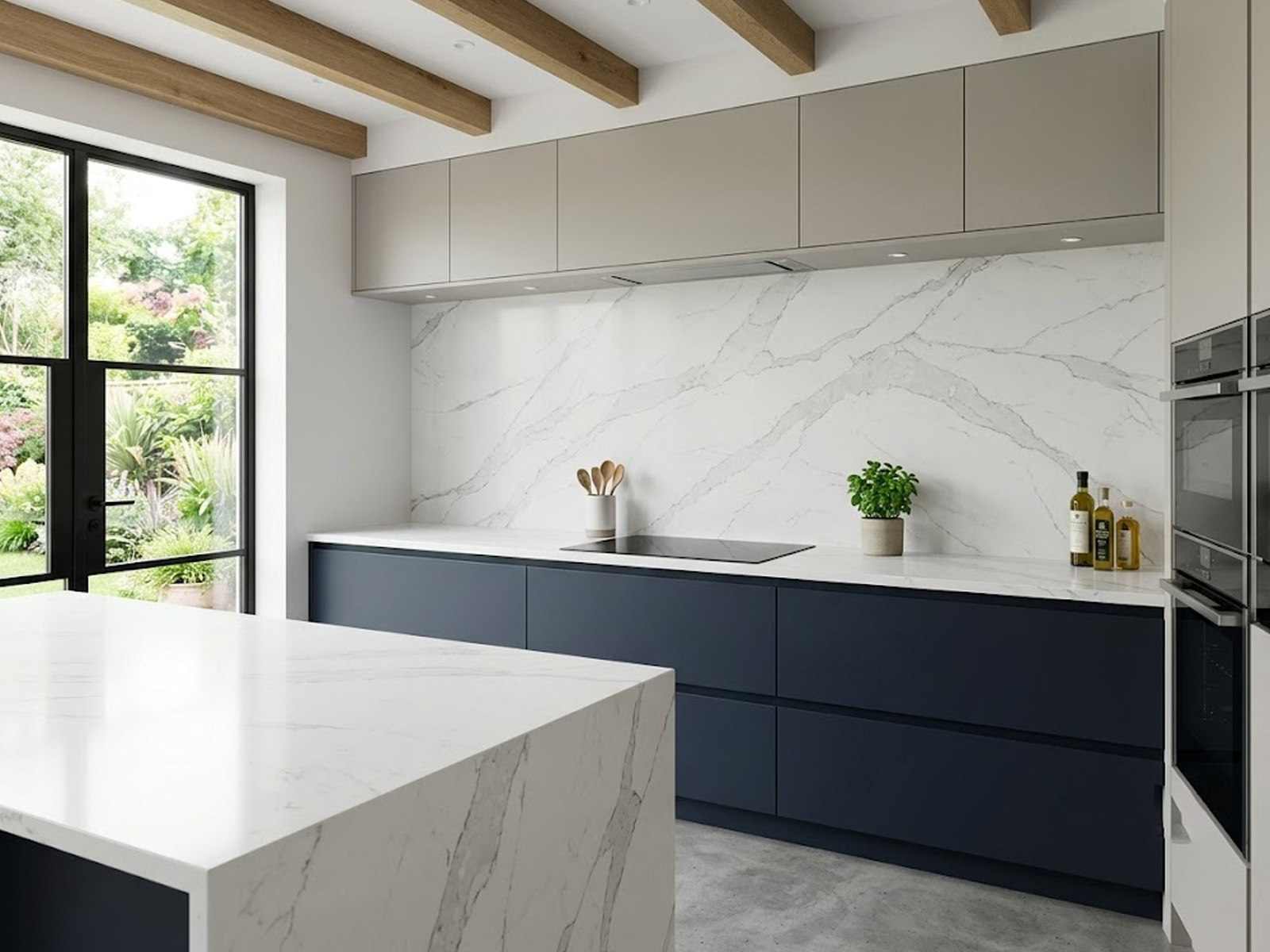
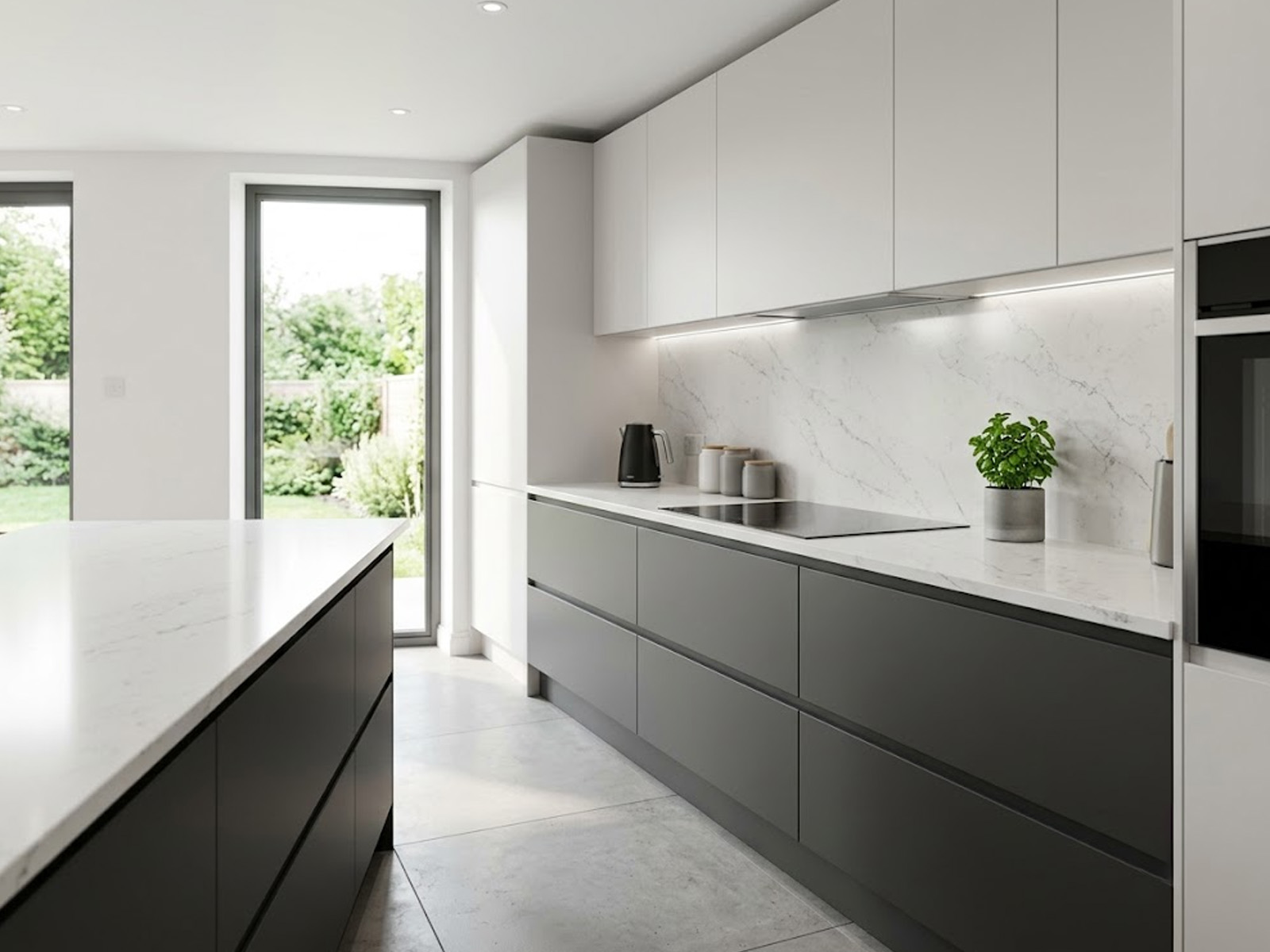
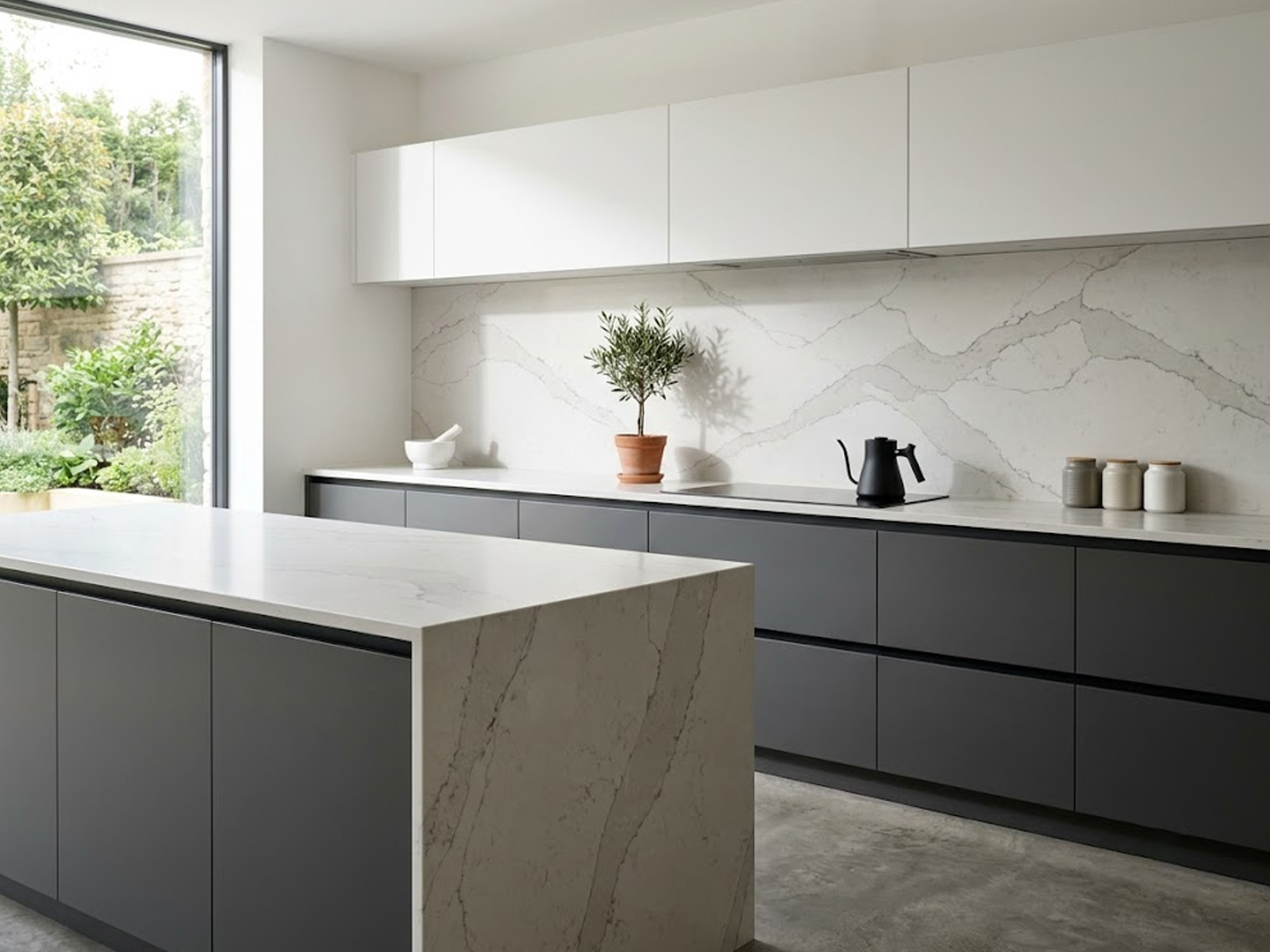
The absolute biggest trend we are executing in 2026 is the full-height stone splashback, where a single, continuous slab of quartz climbs from the worktop directly to the underside of the wall cabinets. This creates a jaw-dropping focal point that completely eliminates dirty grout lines, making daily cleaning as simple as a quick wipe with a microfibre cloth.

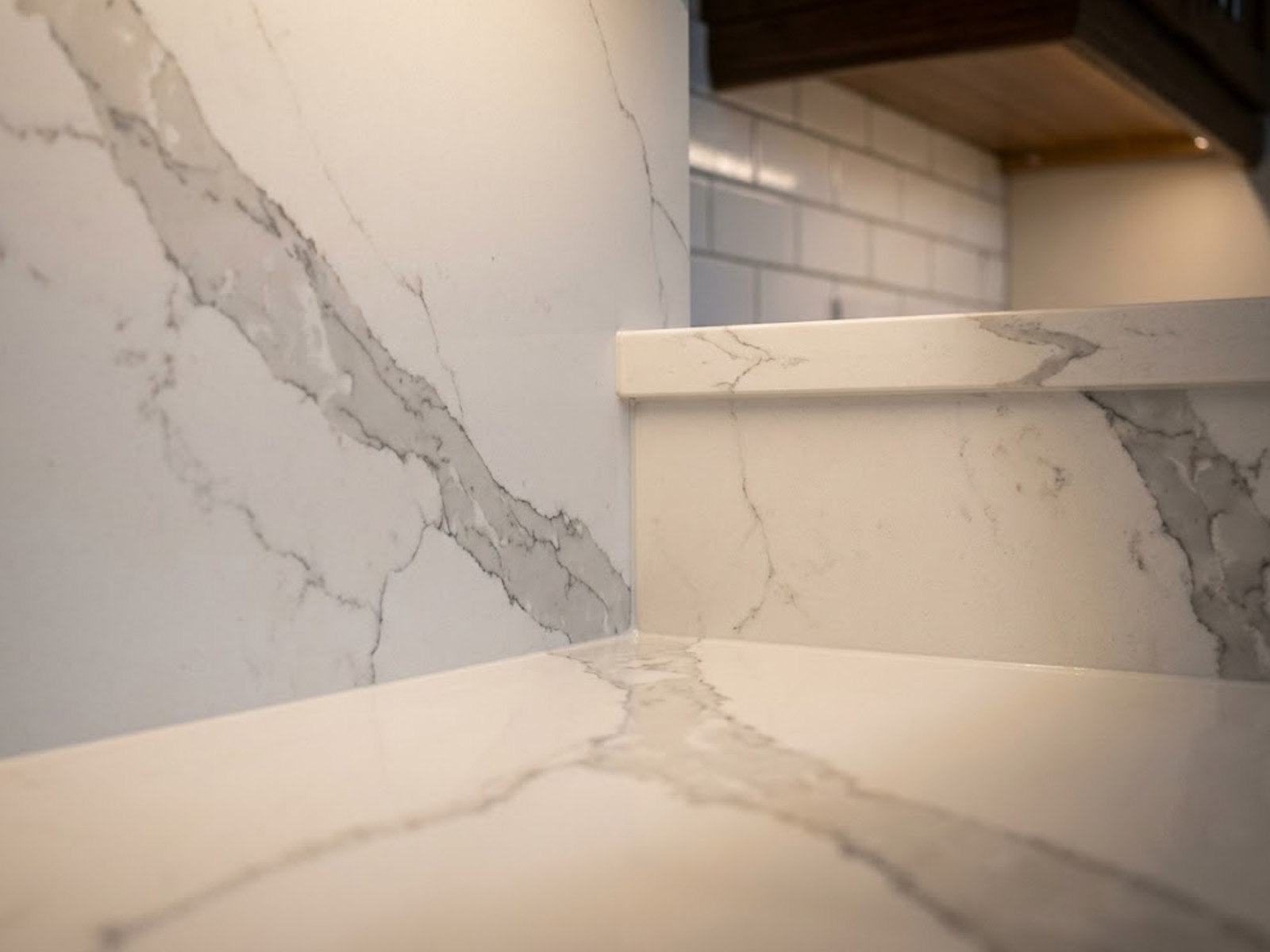
For clients investing in premium Bespoke quartz worktops, extending the material vertically is the ultimate way to display the stone’s intricate character. Slabs with dramatic, flowing Calacatta or Carrara veins act almost like natural artwork when allowed to stretch across the vertical wall space.

This seamless transition makes even compact galley kitchens feel significantly larger, airier, and more architecturally intentional. It brings a sense of modern, uncluttered luxury that traditional tiling simply cannot match.

Quartz-Vein-Matching-Joint

Design Strategy 1: The Monolithic Matching Slab Look

For homeowners who desire a highly polished, high-end showroom aesthetic, using the exact same quartz slab for both the worktop and the splashback is the premier option. This monolithic design strategy ensures that the background shades and veining patterns match with 100% colour consistency.

However, executing this look perfectly requires incredible skill during the initial templating and fabrication phases. We utilise advanced digital laser templating to map the layout of your walls, ensuring that the vertical quartz panels are cut to absolute millimetre precision.

Our master stonemasons then strategically cut the slabs in our workshop to allow the veining to cascade seamlessly from the horizontal deck straight up the wall. This technique, known as ‘vein-matching’ or ‘bookmatching’, creates an organic flow of pattern that instantly signals master-level craftsmanship.

Navigating the Cost of Full-Height Quartz Cladding

While a full-height matching quartz splashback delivers unmatched luxury, it is a significant financial investment that requires careful budgeting. Because you are effectively doubling the square footage of quartz required, you must account for the extra material and fabrication complexity.

To understand the specific financial elements involved, we highly recommend reading our detailed guide on Quartz Worktop Costs in the UK. Proper planning ensures you allocate your budget correctly between raw materials, custom CNC cutting, and professional installation fees.

Choosing a direct-to-consumer fabricator like us allows you to secure these premium slabs at a fraction of high-street retail costs. We manage the entire fabrication and fitting process internally, bypassing expensive retail showrooms and eliminating costly middleman markups.

Design Strategy 2: Creating Contrast with Colours and Textures

If you prefer a more dynamic, multi-layered kitchen design, matching your quartz worktops and splashbacks through thoughtful contrast is highly effective. This approach allows you to highlight different elements of your kitchen, creating depth and character.

One classic method is pairing a highly dramatic, dark quartz worktop with a crisp, light-coloured tile or glass splashback. Alternatively, reversing this contrast by pairing a pristine white quartz worktop with a dark, moody slab splashback creates a striking contemporary edge.

The key to successful contrast is maintaining a shared undertone between the two materials. For example, if your white quartz countertop features warm gold veins, pairing it with a warm cream or beige ceramic tile splashback will ensure the space feels balanced and inviting.

Mixing Matte and Polished Finishes

Combining different surface textures is a sophisticated way to create contrast without introducing too many distracting colours. Pairing a highly polished, reflective quartz worktop with a soft, matte-finished honed splashback creates a stunning play of light.

Conversely, pairing a matte, concrete-effect quartz worktop with a glossy ceramic or glass mosaic tile splashback adds a brilliant touch of shine. This tactile contrast prevents a neutral, monochromatic kitchen from looking flat or clinical.

To explore the specific maintenance and design differences between these textures, read our expert analysis on honed vs polished quartz. Understanding these finishes helps you choose a combination that aligns perfectly with your cooking lifestyle and cleaning habits.

Technical Realities: Templating, Joints, and Cabinet Support

No matter which design direction you choose, the ultimate success of your installation depends entirely on technical precision. Because engineered stone is exceptionally heavy, adding full-height vertical cladding places immense physical loads on your kitchen cabinetry.

Your base cabinets must be constructed from high-quality materials and be perfectly level to distribute the weight of the stone safely. Any structural sag or unlevelness will place the rigid quartz joints under extreme physical tension, risking fractures over time.

For a comprehensive guide on managing structural loads, consult our article on quartz worktop weight support. Taking these structural precautions ensures your kitchen cabinets provide a secure, durable foundation for your premium stone.

Achieving Inconspicuous, Waterproof Joint Seams

Where your horizontal worktop meets your vertical splashback is a highly vulnerable zone that requires a watertight, flexible seal. Our installation teams utilise colour-matched, professional-grade silicone sealants to seal this intersection, preventing moisture from seeping behind your cabinets.

If your layout requires multiple vertical panels to meet in a corner, we use two-part structural epoxy resins to create nearly seamless joints. This technical approach guarantees a highly hygienic, flush finish that prevents bacteria and cooking grease from gathering in gaps.

Material Performance Comparison: Quartz vs Tile vs Glass

Selecting the perfect material for your wall cladding requires balancing aesthetic appeal with long-term durability and maintenance. While traditional tiles remain a popular option, engineered quartz easily outperforms other materials in terms of hygiene and longevity.

Our advanced workshop processes premium materials to strict standards, allowing us to maintain complete quality control. The table below compares how quartz performs as a splashback material compared to traditional ceramic tiles and toughened glass.

Splashback MaterialGrout LinesStain & Moisture ResistanceCustom Pattern MatchingEase of Daily Cleaning
Engineered QuartzNone (Seamless slabs)100% Non-PorousExcellent (Vein alignment)Extremely Easy (Wipe clean)
Ceramic TilesHigh (Requires sealing)High (But grout stains)Poor (Repeated tile designs)Moderate (Grout scrub needed)
Toughened GlassNone (Single panels)100% Non-PorousLimited (Solid colours only)Easy (But shows streaks)


Safe Fabrication and Professional Installation Standards

The fabrication of dense engineered quartz, whether for a flat worktop or vertical wall panels, generates fine crystalline silica dust. This fine particulate matter poses severe health risks if inhaled, demanding strict dust-suppression protocols in modern workshops.

Our state-of-the-art manufacturing facility operates in absolute compliance with the occupational safety regulations set by the gov.uk Health and Safety Executive. We utilise advanced wet-cutting CNC machinery and industrial water-filtration systems to completely suppress hazardous silica dust.

This commitment to safety protects our master stonemasons while ensuring your custom-milled worktops arrive at your home completely clean. It reflects our dedication to executing kitchen renovations to the highest professional, ethical, and environmental standards.

The Direct-to-Consumer Advantage with Austin

Partnering with an independent, direct-to-consumer fabricator is the best way to secure premium stone without paying inflated high-street showroom prices. Because we manage every stage of the process internally, we eliminate expensive middlemen markups.

At Austin Laminate Countertops, our integrated business model means we handle your digital laser templating, CNC cutting, edge profiling, and final installation. This streamlined approach guarantees absolute quality control and a deeply transparent pricing structure.

Investing in a professionally fitted, seamless stone kitchen is also an excellent way to boost your property’s resale value. For more details on the financial benefits of stone, read our analysis on do quartz worktops add value to a UK home?.

Secure Your Free Bespoke Kitchen Estimate Today

Stop relying on vague online estimates and secure a highly accurate, transparent quotation tailored to your kitchen’s unique dimensions. Our in-house specialists are ready to guide you through material thickness options, colour selections, and splashback matching strategies.

We will carefully analyze your kitchen layout to ensure your base cabinetry and walls are perfectly prepared for the weight of premium stone. Our master stonemasons guarantee a flawless, stress-free installation that will stand the test of time.

Submit your dimensions or kitchen plans today to receive an accurate, competitive estimate by requesting a Free Quote through our secure portal. Let our dedicated team transform your home with guaranteed engineering precision and direct-to-consumer value.

Do You Need Extra Cabinet Support for Heavy Quartz Worktops?

Yes, you generally require extra cabinet support for heavy quartz worktops if your base units are built from thin materials like MDF or if your layout features massive spans and overhangs. Because engineered stone is incredibly dense, standard budget cabinetry can sag or warp, leading to devastating structural cracks.

Essential Quartz Structural Support Requirements:

  • Overhangs exceeding 200–300mm: Strictly require heavy-duty steel support brackets.

  • Sub-standard base cabinetry: Thin MDF or particleboard frames must be structurally reinforced with plywood sub-tops.

  • Span integrity: Large open spans over appliances must have steel or timber support rails fitted.

The Science Behind Quartz Worktop Weight Support

Engineered stone combines roughly 90% natural quartz crystals with advanced polymer resins under intense heat and vibration. This manufacturing process produces an incredibly dense material that weighs approximately 50kg to 75kg per square metre depending on thickness.

As master stonemasons, we must carefully calculate how this immense mass interacts with your timber cabinetry. Proper quartz worktop weight support ensures the structural load is distributed evenly across all vertical panels, preventing localised pressure points.

Our fabrication facility utilises advanced technology to prepare each slab, but the ultimate success of the installation relies on your cabinetry. Without a structurally sound foundation, the heavy stone will flex, placing the joints under extreme physical tension.

Structural Evaluation: Will Your Cabinets Handle the Load?

Before our team arrives to fit your new surfaces, you must evaluate the material, age, and construction of your base units. Cabinets constructed from high-quality plywood or solid timber are highly robust and easily carry the heavy weight without bowing.

However, budget kitchens made from thin particleboard or low-density MDF often require additional wood battens or steel braces. If you are concerned about your current cabinet integrity, the team at Austin Laminate Countertops can assess your layout during the initial design phase.

Our digital laser templating tools map the exact perimeter of your cabinets to identify potential structural sag. Addressing these weak points before installation ensures your cabinets remain perfectly rigid, preventing long-term structural alignment issues.

Overhangs and Cantilevers: Why Brackets Are Essential

Breakfast bars and kitchen island seating areas create beautiful, modern design statements but introduce significant structural vulnerabilities. Because engineered stone cannot support its own weight over large cantilevers, unsupported overhangs will crack under minimal downward pressure.

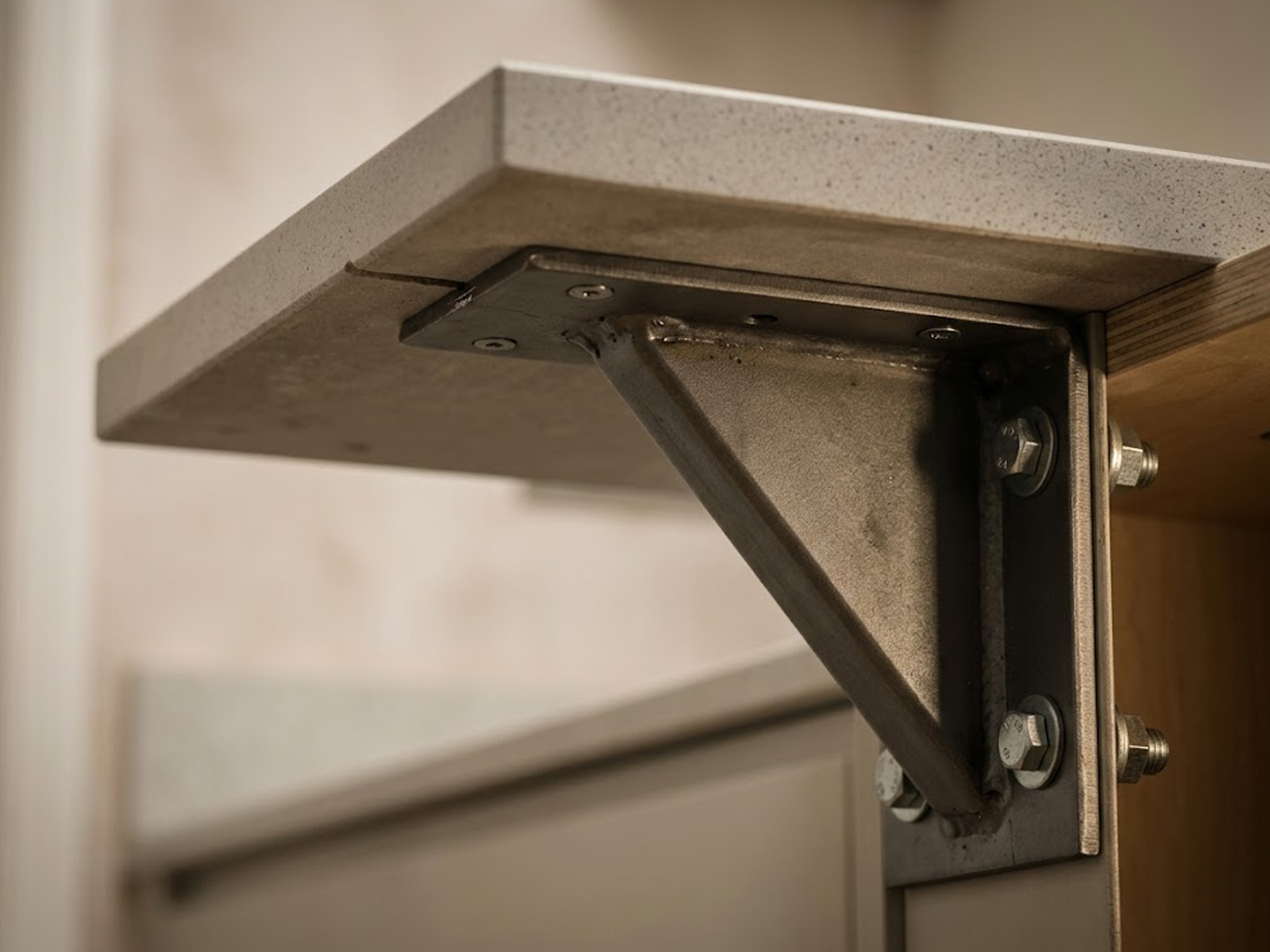
We enforce strict guidelines: any overhang exceeding 300mm requires heavy-duty steel support brackets or solid pillars. These hidden brackets mount directly to your cabinet frames or wall studs to redirect the load away from the edge of the stone.

For clients designing dramatic floating islands, our Bespoke quartz worktops can be paired with custom-engineered cantilever supports. These specialised steel systems provide maximum safety while keeping the knee space completely open and unobstructed.

Heavy-Duty-Steel-Support-Bracket

How Thickness Influences Quartz Worktop Weight Support

The thickness of your chosen slab dictates both the total weight of the installation and how the stone distributes its load. While a thicker slab is heavier, it actually possesses greater inherent stiffness and is less prone to flexing over moderate spans.

When deciding on 20mm vs 3mm quartz, you must consider that 20mm slabs require continuous support beneath them. Thinner stone profiles must be fitted on a solid timber top or reinforced with steel rails to prevent flexing.

Our master stonemasons calculate the exact structural requirements for both profiles during the CNC cutting phase. While 30mm quartz is heavier for your cabinets, its rigid structure requires fewer support brackets over standard breakfast bar overhangs.

Common Installation Mistakes That Jeopardise Structural Integrity

One of the most frequent errors we observe is homeowners attempting to install heavy stone onto unlevel base cabinetry. If the cabinet tops deviate by even two millimetres, the rigid stone will rest on a few high points rather than the entire frame.

This uneven loading creates immense stress concentrations, which will eventually cause the stone to crack at its weakest points. For a deeper look into the material’s structural limitations, we suggest reading about the pros and cons of quartz worktops.

Another common mistake is choosing the wrong material or edge profile for a high-impact, busy family kitchen. To keep your stone looking pristine, always verify that your cabinets are level before our fitting team arrives.

Under-mount Sinks and Tap Holes: Stress Points in the Stone

Cutting large voids into your stone slab for sinks, hobs, and taps drastically reduces the structural strength of that section. These cutouts create weak corridors that require dedicated, localised quartz worktop weight support beneath the cabinet frame.

We install heavy-duty steel support rails across the sink cabinet to carry the weight of both the water-filled sink and the stone. This ensures the delicate, narrow bridges of stone surrounding your sink are not subjected to downward structural stress.

Our precise cutting methods ensure every cutout features rounded internal corners, as sharp cuts act as stress accumulators. For a full breakdown of what happens on fitting day, read about the quartz worktop installation process.

Material Comparison: Structural Load and Support Demands

Understanding how different materials load your cabinetry helps when planning your kitchen’s structural support. While laminate is exceptionally light, it lacks the luxurious appeal and absolute durability of engineered stone.

The table below outlines the average weights, typical support requirements, and relative flexural strength of popular kitchen surfaces.

Material TypeAverage Weight (Per Sq M)Continuous Base Required?Max Unsupported Overhang
Engineered Quartz50kg – 75kgYes (For 20mm profiles)300mm (For 30mm thickness)
Natural Granite55kg – 80kgYes (always).250mm – 300mm
High-Pressure Laminate12kg – 18kgNo150mm


Safe Fabrication Standards and UK Regulations

Fabricating dense engineered stone generates fine crystalline silica dust, which must be strictly managed within our modern workshop. Our facility operates with advanced wet-cutting CNC machinery and high-efficiency particulate air filtration to protect our staff.

Our operations comply entirely with the rigorous workplace health and safety guidelines enforced by the gov.uk Health and Safety Executive. This unwavering commitment to safety guarantees that your bespoke worktops are produced under highly ethical and clean conditions.

By suppressing dust at the source, we ensure our stonemasons work in a clean environment while delivering pristine slabs to your home. This professional diligence protects both our workers and the high quality of your finished stone.

Maximising Your Return with Direct Stone Fabrication

Securing the best structural support for your kitchen shouldn’t require paying inflated high-street showroom prices. Because we handle every step of the process internally, we can offer premium materials at highly competitive rates.

By avoiding expensive retail middlemen and third-party contractors, we pass the direct-to-consumer savings directly to you. To explore the cost factors involved in these premium installations, read about Quartz Worktop Costs in the UK.

Our integrated business model means we handle your digital laser templating, CNC cutting, and final professional installation. This streamlined approach guarantees impeccable quality control and an exceptionally high return on your home investment.

Secure Your Free Bespoke Kitchen Estimate Today

Stop guessing about your kitchen’s structural readiness and start planning your renovation with true stone installation experts. Our dedicated team is ready to guide you through material thickness options, support requirements, and custom edge profiles.

We will carefully analyse your kitchen layout to ensure your base cabinetry provides the perfect foundation for your new stone. Our master stonemasons guarantee a flawless, stress-free installation that will stand the test of time.

Submit your cabinet dimensions or kitchen plans today to receive a highly accurate, transparent price estimate. Visit our secure online portal now to request your bespoke Free Quote and schedule your professional digital laser templating visit.

Silestone vs Caesarstone: A Comparison of Premium Quartz Brands

When comparing Silestone vs Caesarstone for your kitchen renovation, both premium brands offer exceptional durability, but they cater to slightly different design priorities.

  • Silestone: Manufactured by Cosentino, featuring innovative HybriQ+ technology with recycled content, a massive range of colours, and three distinct surface textures (polished, suede, and volcano).

  • Caesarstone: Renowned for pioneering engineered quartz, offering incredibly realistic natural marble-effect patterns, industrial concrete aesthetics, and superior tactile finishes.

  • Verdict: Choose Silestone if you want advanced eco-friendly technology and versatile textures, or select Caesarstone if your priority is achieving the absolute pinnacle of realistic, organic veining.

Fabricator Insights on Silestone vs Caesarstone

Deciding between Silestone vs Caesarstone requires looking beyond marketing brochures and assessing how these heavy slabs perform under the CNC cutting blade. As experienced stonemasons, we handle both premium materials daily in our specialised workshop.

We template every custom kitchen layout to strict millimetre tolerances, ensuring a seamless fit against your walls. Both brands utilise high-pressure compression techniques to eliminate internal air pockets, producing structurally dense slabs that resist cracking.

However, the slight differences in their synthetic binder formulations can subtly affect how the edges respond to custom profiling. Achieving a perfectly smooth pencil or bullnose edge requires our team to calibrate our wet-cutting speeds with absolute precision.

The Technological Battle: Cosentino HybriQ+ vs Caesarstone Pioneering

The manufacturing science of Silestone vs Caesarstone highlights two completely different approaches to modern stone engineering. Silestone utilises Cosentino’s proprietary HybriQ+ technology, which significantly alters the composition of the slab.

This advanced process replaces a large portion of crystalline silica with a blend of premium recycled minerals and glass. This eco-friendly shift helps fabricators comply with strict occupational health rules while maintaining the material’s legendary scratch resistance.

Conversely, Caesarstone continues to refine the traditional vibro-compression method they pioneered in the late 1980s. Their slabs maintain a highly consistent ratio of natural quartz aggregates to polymer resins, ensuring outstanding structural rigidity across vast spans.

Environmental Impact and Workplace Safety

Workplace safety is a major factor in the UK stone industry, particularly regarding the control of hazardous crystalline silica dust. Cutting dense engineered materials demands strict adherence to wet-processing techniques to protect workshop staff.

At our modern facility, we operate in complete compliance with the occupational safety guidelines enforced by the gov.uk Health and Safety Executive. Silestone’s HybriQ+ slabs, with their reduced silica content, represent a progressive step forward for workplace safety.

Furthermore, utilising recycled water and renewable energy during the manufacturing phases makes Silestone highly appealing to eco-conscious homeowners. Caesarstone has also adapted, introducing low-silica product lines to meet evolving global environmental standards.

Silestone-Suede-Texture-Macro

Comparing Aesthetics: Textures, Colours, and Veining

When clients compare silestone vs caesarstone in our showroom, their final decision usually comes down to visual texture. Both brands excel at mimicking natural stone, but they achieve their looks through different aesthetic styles.

Silestone is highly celebrated for its diverse texture options, offering polished, suede (matte), and volcano (rugged) finishes. This variety allows you to customise the tactile experience of your Bespoke quartz worktops to match your cabinetry.

Caesarstone, meanwhile, is widely regarded as the industry master of organic, irregular veining patterns and realistic concrete finishes. Their supernatural collection captures the chaotic beauty of raw quarried marble without any of its frustrating structural weaknesses.

Suede Finish vs Concrete Matte Textures

Silestone’s Suede texture is an exceptionally smooth, soft-touch matte finish that behaves beautifully under warm under-cabinet LED lighting. It diffuses light gently, preventing the harsh, glaring reflections often associated with highly polished kitchen surfaces.

Caesarstone’s matte and concrete finishes offer a slightly more textured, raw tactile feel that perfectly complements modern industrial spaces. However, these organic textures require a slightly more frequent cleaning routine to keep grease smudges at bay.

Durability and Daily Maintenance Realities

Evaluating the daily resilience of Silestone vs Caesarstone reveals that both premium brands easily outperform natural granite and marble. Their non-porous surfaces ensure that spilt wine, lemon juice, or coffee cannot penetrate the core to cause staining.

Because both materials are bound with synthetic resins, they require absolutely no annual chemical sealing or specialist waxing. A simple routine using warm water and a mild, pH-neutral dish soap is entirely sufficient to keep them looking pristine.

However, neither brand is completely heat-proof, as extreme thermal shock can scorch or crack the internal polymer binders. To protect your worktops, always use protective wooden trivets or integrated metal rails near your cooking hob.

Dealing with Stubborn Food Spills Safely

A common mistake homeowners make is using abrasive scouring powders or metal blades to scrape away dried-on grease. These aggressive cleaning tools can micro-scratch the polished surface, permanently dulling the stone’s factory finish.

For safe, stonemason-approved cleaning tips, check out our guide on how to clean quartz worktops. Using the correct cleaning methods preserves the beautiful sheen of your worktops for decades.

Cost Analysis: Silestone vs Caesarstone Investment

Analysing the budget required for Silestone vs Caesarstone reveals that both occupy the premium tier of the UK market. The final price of your project is heavily influenced by the specific design collection and material thickness you select.

Choosing between 20mm and 30mm profiles will also alter your total material costs and structural support requirements. For a detailed cost breakdown of stone renovations, refer to our comprehensive article on Quartz Worktop Costs in the UK.

Feature ComparisonSilestone Quartz SlabsCaesarstone Quartz Slabs
Silica FormulationHybriQ+ (Reduced silica content)Traditional & Low-Silica options
Surface TexturesPolished, Suede, VolcanoPolished, Honed, Concrete, Rough
Warranty Length25-Year transferable warrantyLifetime residential warranty
Material Thicknesses12mm, 20mm, 30mm13mm, 20mm, 30mm


Bypassing High-Street Showroom Markups

Securing the best value for your chosen premium brand means avoiding expensive retail showrooms that inflate prices with massive middlemen margins. Because we handle every single step internally, we can offer highly competitive pricing structures on all premium stones.

At Austin Laminate Countertops, our direct-to-consumer approach means we manage the digital templating, the CNC cutting, and the final installation. This streamlined model guarantees absolute quality control and ensures your surfaces are fitted with absolute engineering precision.

The Importance of Precise Templating and Level Cabinets

The ultimate success of your installation relies entirely on the quality of the preparation work completed before the stone arrives. Because engineered stone is incredibly heavy, it requires robust, perfectly level cabinetry to prevent future stress fractures.

If our fitting team detects that your base cabinets are unlevel, the installation cannot proceed safely. Placing rigid stone onto uneven supports creates physical tension points, which can cause the slab to crack near cutouts or joints.

We utilise advanced digital laser templating to map your kitchen layout down to strict millimetre tolerances before cutting. This precise approach ensures clean, minimal joint lines and consistent overhangs across your entire cabinetry layout.

Final Verdict: Choosing Between Silestone vs Caesarstone

Ultimately, deciding between Silestone vs Caesarstone comes down to matching their unique product strengths with your personal design goals. If you prioritise eco-friendly manufacturing, diverse textures, and a 25-year warranty, Silestone is an outstanding choice.

However, if you are seeking the absolute pinnacle of realistic marble veining and tactile industrial concrete finishes, Caesarstone remains the gold standard. Both premium brands will dramatically elevate the luxury, functionality, and value of your home for decades.

Secure Your Professional Stone Estimate Today

Stop guessing about your upcoming renovation costs and get a transparent, highly accurate quotation tailored to your kitchen’s unique dimensions. Our in-house specialists are ready to guide you through thickness options, edge profiles, and colour selections.

Submit your kitchen plans or dimensions today and schedule your professional digital laser survey by requesting a Free Quote through our secure portal. Let our master stonemasons transform your kitchen with guaranteed engineering precision and direct-to-consumer value.

Are Joints Visible on Quartz Worktops?

Yes, joints are physically present and slightly visible on quartz worktops, as it is impossible to fuse solid engineered stone slabs together without a seam. However, a highly skilled stonemason utilising digital templating, colour-matched epoxy resin, and professional seam setters can make these joints practically inconspicuous to the naked eye.

  • Average Seam Width: Properly fabricated joints are extremely narrow, measuring less than 1.5 millimetres across.

  • Tactile Feel: A professionally fitted joint is completely flat, smooth, and level, with zero catching or jagged edges.

  • Visual Factors: Solid, lighter colours make seams harder to see, whereas complex Calacatta patterns require expert vein matching.

  • Hygienic Seal: The seam is completely filled with waterproof adhesive, ensuring no food particles or bacteria can penetrate.

Every modern kitchen design requiring a layout longer than three metres will inevitably have seams. Understanding how quartz worktop joints visible in your home behave is essential for setting realistic design expectations before your fitting day.

The physical limitations of transporting vast slabs mean we cannot deliver single pieces that span the entire length of large open-plan kitchens. Slabs typically measure around three metres in length, meaning long runs, L-shaped corners, and breakfast bars require strategic cuts.

When we plan a kitchen layout, we focus heavily on locating these seams in discrete, structurally sound areas. A poorly positioned seam not only compromises the visual flow of your workspace but can also lead to structural failures over time.

How Material Patterns Affect Quartz Worktop Joints Visibly

The intricate patterns, veining, and base colours of your selected stone play a monumental role in how prominent your joint will look. Solid greys, warm taupes, and fine-grained patterns are exceptionally forgiving, allowing us to blend the seam seamlessly into the background.

If you choose a highly complex, heavily veined Calacatta marble design, matching the veins across a joint is a complex task. We must carefully align the sweeping patterns during the cutting phase to avoid a jarring, artificial visual break in your kitchen island.

We always advise clients selecting these dramatic designs to review our guide on popular quartz worktop colours in the UK. Selecting the perfect pattern ensures that your joint lines complement, rather than disrupt, your kitchen’s natural design.

Solid and Fine-Grained Quartz Patterns

Fine-grained textures or solid colours are the easiest to join because they do not have linear directional patterns that can misalign. The uniform distribution of quartz crystals across the seam makes the joint practically disappear when filled with a colour-matched adhesive.

We routinely install these simpler designs in contemporary galley kitchens, ensuring the focus remains on the clean lines of the cabinetry. These uniform options are ideal for property owners who prioritise a completely uninterrupted, monolithic surface aesthetic.

Quartz-Worktop-Seam-Precision

Heavily Veined Calacatta and Carrara Designs

Marble-effect slabs require a highly artistic eye and advanced digital templating to ensure the bold grey or gold veins flow naturally across the seam. Without careful planning in our workshop, a joint can make the pattern look disconnected, ruining the luxurious aesthetic.

To achieve a flawless flow, we often need to cut multiple pieces from consecutive slabs, which can slightly increase the total material required. If you are researching these high-end options, review Bespoke quartz worktops to see how we manage veining.

Technical Factors That Control Quartz Worktop Joint Visibility

The visual success of any stone seam is directly dictated by the precision of the manufacturing machinery and the skill of the installers. At our workshop, we utilise advanced water-jet CNC cutters to achieve incredibly clean, straight edges that are completely free from microscopic chips.

Even minor chipping along the cut edge will trap the tinted epoxy, creating a dark, jagged line that makes the joint highly prominent. Hand-cutting stone on-site with manual tools cannot replicate this factory-level precision, which is why in-house fabrication is mandatory.

Once the stone arrives at your home, our installers use specialised mechanical seam-setting tools to pull the pieces together under immense pressure. These suction-cup devices level the slabs perfectly while the chemical resin cures, eliminating any slight height differences.

The Role of Colour-Matched Epoxy Resin

We do not use standard clear silicone to join premium stone surfaces; instead, we utilise advanced two-part structural epoxy resins. We manually mix specific colourants to match both the base background of the slab and any accent veining running through the seam.

This colour-matching process is a true craft, requiring a keen eye for tone, depth, and the reflective properties of the engineered stone. Once the resin is packed into the joint and fully cured, we carefully shave away the excess to leave a completely flush finish.

For a detailed walkthrough of the physical installation process, consult What to Expect During a Professional Quartz Worktop Installation. Understanding this sequence highlights the level of care required to deliver an immaculate, smooth joint.

The Critical Need for Perfectly Level Base Cabinets

A common, costly mistake that compromises a joint is placing heavy stone slabs onto unlevel wooden kitchen cabinetry. If the base cabinets dip by even a single millimetre across the layout, it places the rigid stone under permanent physical tension.

This tension makes it impossible to align the joint flat, leading to “lippage,” where one side of the seam sits slightly higher than the other. This uneven edge will quickly chip when struck by sliding pots, highlighting why cabinet preparation is vital.

We always verify the levelness of your supporting carcasses during our initial digital laser survey to prevent these fitting issues. Proper preparation ensures that your cabinets are structurally ready to support the immense weight of your new surfaces safely.

Comparing Joint Quality Across Different Kitchen Worktop Materials

Different kitchen surfaces react uniquely to the seaming process, with engineered stone delivering the most sanitary and robust joints. While laminate is prone to water damage at the seams, engineered quartz remains completely non-porous and waterproof.

We consistently find that engineered surfaces easily outperform natural granite when it comes to creating unnoticeable, tight seams. The table below compares the typical joint widths, sealing requirements, and overall hygiene levels of popular kitchen worktops.

Material TypeAverage Joint WidthJoint WaterproofingSealing Required at Joint
Engineered Quartz< 1.5 mm (Very tight)100% WaterproofNever
Natural Granite1.5 mm – 2.5 mmWaterproof (epoxy-sealed)Annually
Laminate1.5 mm – 2.0 mmVulnerable to water swellingEdge sealant required


Why Porosity Matters for Joint Longevity

Natural granite is naturally porous, meaning that moisture can slowly seep into the edges around a joint if the chemical sealant degrades. Over time, this water ingress can discolour the stone or weaken the adhesive bond, leading to a visible separation of the seam.

Because engineered stone is non-porous, the colour-matched epoxy forms a permanent, impenetrable bond that resists bacteria and moisture. To learn more about how these structural differences impact maintenance, read our comparison of quartz vs granite worktops.

Preventing Damage and Stains Along Your Quartz Worktop Joints

Once your worktop is installed, caring for the joint line properly will keep the seam looking immaculate and sanitary for decades. The cured resin adhesive is highly durable but remains slightly more sensitive to chemical cleaners than the engineered stone itself.

You should avoid scrubbing the joint line with abrasive scourers or using highly acidic or alkaline chemicals like neat bleach. To understand safe maintenance practices, read our comprehensive guide on how to clean quartz worktops.

Additionally, never place intense heat sources, such as a boiling hot pan or a slow cooker, directly over or near a joint. Extreme thermal shock can cause the resin adhesive to scorch or crack, weakening the seam and requiring professional repair.

Heat Protection and Thermal Shock Prevention

While engineered stone is highly durable, the polymer resins used to bind the quartz crystals together are sensitive to thermal shock. Placing hot pans on a cold worktop can cause localised expansion, placing immense physical stress on the nearest joint.

We always instruct clients to use protective wooden trivets or integrated metal bars near their hobs to protect the stone. For more detailed safety guidelines regarding heat, see our expert article Can You Put Hot Pans Directly on Quartz Worktops?.

Establishing these basic habits preserves both the structural integrity of your seams and the warranty of your stone surfaces. It ensures your kitchen remains a safe, highly hygienic environment for daily food preparation and cooking.

Safe Fabrication Practices and UK Safety Standards

Processing dense engineered stone generates fine crystalline silica dust, which must be managed strictly to protect health and safety. Our modern fabrication facility utilises advanced wet-cutting CNC machinery to suppress this dust completely during production.

Our workshop operates in absolute compliance with the rigorous occupational safety regulations enforced by the gov.uk Health and Safety Executive. This unwavering commitment guarantees a safe working environment for our skilled stonemasons and an uncontaminated product for your home.

Adhering to these strict standards ensures your bespoke worktops are cut, polished, and joined using the safest industry techniques. It reflects our dedication to delivering craftsmanship that is both beautiful and manufactured to the highest ethical standards.

The Austin Direct-to-Consumer Value Proposition

Choosing an independent, direct-to-consumer fabricator is the best way to secure premium stone surfaces without paying inflated showroom prices. By managing the entire process internally, we eliminate expensive middlemen markups and retail commissions.

At Austin Laminate Countertops, we handle digital laser templating, CNC cutting, edge profiling, and final installation ourselves. This streamlined model allows us to offer premium materials and impeccable joint precision at a highly competitive price point.

Secure Your Precision Kitchen Estimate Today

Stop guessing about your upcoming renovation costs and get a transparent, highly accurate quotation tailored to your kitchen’s unique dimensions. Our in-house team is ready to guide you through material thickness options, colour selections, and joint placement strategies.

Submit your kitchen plans or dimensions today to receive an accurate, competitive estimate by requesting a Free Quote through our secure portal. Let our master stonemasons transform your kitchen with guaranteed engineering precision and direct-to-consumer value.